
Yini i-CMMS? Umhlahlandlela Ophelele Wemisebenzi YaseNingizimu Afrika
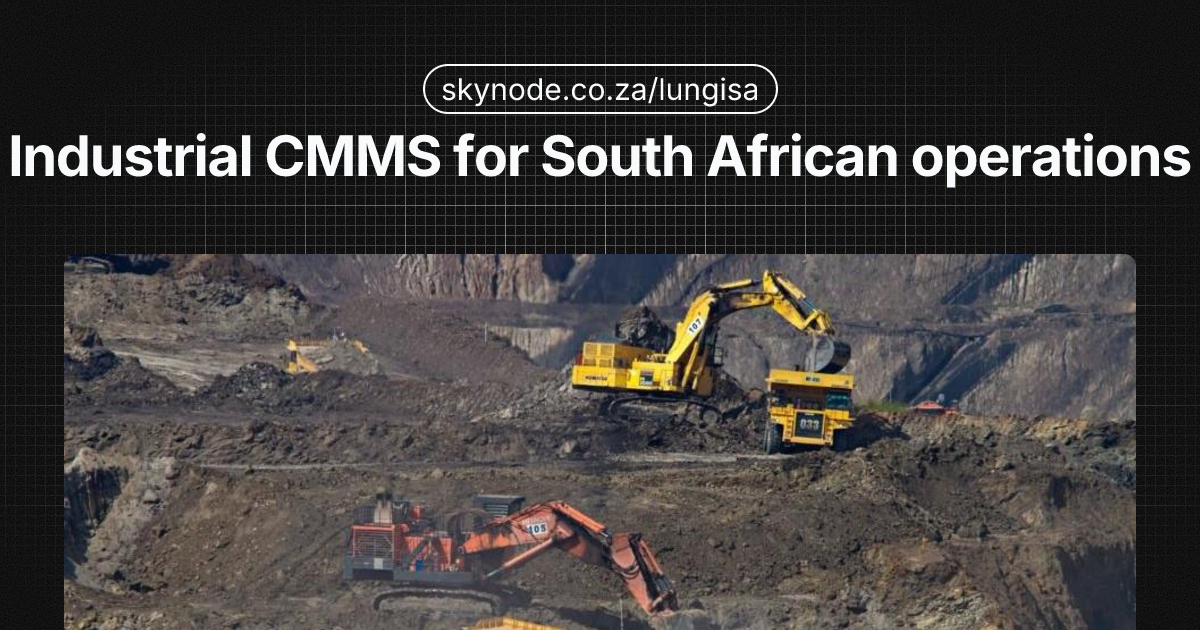
Ukuphahleka okungahlelekile kubiza imayini namafektri aseNingizimu Afrika ngaphezu kokukhiqiza okulahlekile. They drive overtime, rush parts orders, and, when maintenance records are missing or incomplete, they put operations at risk under the OHS Act and the Mine Health and Safety Act (MHSA). A single Section 54 stoppage or compliance finding can cost hundreds of thousands of rands and damage reputations. What is CMMS in that context? It is the digital system that replaces paper job cards, Excel spreadsheets, and foreman memory with one place to plan, schedule, track, and prove maintenance.
A CMMS, or computerised maintenance management system, is software that helps you plan, schedule, track, and report on maintenance work. It centralises work orders, asset histories, spare parts, and compliance records. For South African businesses facing load-shedding, strict safety rules, and pressure to cut downtime and costs, a CMMS is the practical backbone of how maintenance gets done. This guide explains what a CMMS is, how it works, who needs one, and how to choose maintenance management software that fits the South African context, from a gold mine in Gauteng to a food factory in KwaZulu-Natal, and from a single plant to multi-site operations.
What is CMMS and How Does It Work?
CMMS stands for Computerised Maintenance Management System. Sometimes you’ll see it written as “CMMS software” or “maintenance management software”; they refer to the same idea: a digital system that centralises how you manage maintenance. Before CMMS, many operations relied on paper job cards, Excel spreadsheets, or nothing more than a foreman’s memory. That approach breaks down as you add assets, sites, and compliance requirements.
A CMMS replaces that patchwork with a single system where work orders are created, assigned, and completed; assets are recorded with full history; and reports give you a clear picture of uptime, costs, and compliance. In South Africa, where mines and factories must prove they’re maintaining equipment safely and in line with the Mine Health and Safety Act (MHSA) and the Occupational Health and Safety Act (OHS Act), having that audit trail in one system is not just convenient, it’s often mandatory.
A CMMS works by linking four main elements: assets, work, parts, and people.
You start by building an asset register: every piece of equipment (pumps, conveyors, vehicles, HVAC, etc.) is recorded with details like location, make, model, and criticality. Each asset can then be linked to preventive maintenance (PM) schedules, for example, “lubricate bearing every 500 hours” or “inspect safety valve monthly.” The system generates work orders automatically when those schedules are due.
When something breaks or needs ad-hoc attention, you create a reactive work order. Technicians receive the job (on a phone, tablet, or printout), complete the work, and log what they did, what parts they used, and how long it took. That information feeds back into the asset history and into inventory: the CMMS can track spare parts and trigger reorder alerts so you’re not caught short during load-shedding or a breakdown.
Finally, reporting pulls it all together: MTBF (mean time between failures), backlog, compliance completion rates, and cost per asset. Managers and auditors can see at a glance whether maintenance is on track and where to focus next. In practice, a CMMS turns maintenance from a reactive, document-heavy chore into a planned, traceable process, which is exactly what South African operations need when inspectors ask for proof of maintenance or when you’re trying to reduce unplanned downtime.
Core Modules in a CMMS
Not every CMMS has the same modules, but the following are the core building blocks of a solid maintenance management system.
Work Orders
Work orders are the heart of a CMMS. Each job, whether preventive or reactive, is a work order with priority, assigned technician, due date, and checklist or instructions. Technicians can update status (open, in progress, completed) and add notes, photos, or time spent. In South Africa, where shift work and remote sites are common, work orders that work on mobile (and ideally offline) are especially valuable: a technician in a plant in Durban or on a mine in Limpopo can capture work even when connectivity is poor or the grid is down.
Preventive Maintenance (PM) Scheduling
PM scheduling lets you define recurring tasks by time (e.g. weekly, monthly) or by usage (e.g. every 1 000 running hours). The CMMS generates work orders automatically so nothing falls through the cracks. For MHSA and OHS Act compliance, this is where you prove that critical equipment is maintained on a defined schedule. Many operations also use PM to plan around production windows or load-shedding slots so maintenance doesn’t clash with peak running times.
Asset Register
The asset register is your single list of every maintainable asset: machinery, vehicles, buildings, and even infrastructure like electrical substations. Each asset typically has a unique ID, location, specifications, and links to manuals or procedures. Over time, the CMMS builds a full history of all work done on that asset, essential for root-cause analysis, warranty claims, and answering auditors. In a multi-site operation (e.g. several plants or mine sections), the asset register keeps everything organised by site and department.
Inventory and Spare Parts
A CMMS can track spare parts and consumables: what’s in stock, where it’s stored, min/max levels, and which work orders consume which parts. Low-stock alerts help you reorder before a critical failure. For South African operations, holding the right spares matters more when supply chains or load-shedding cause delays; a CMMS helps you prioritise what to keep on site and what to order in advance.
Reporting and Dashboards
Reporting turns data into decisions. Common reports include: backlog (open work orders), PM compliance (percentage of scheduled tasks completed on time), MTBF and MTTR (mean time to repair), cost per asset or department, and compliance status for safety and legal requirements. Dashboards give managers a quick view of KPIs without digging through spreadsheets. When you’re preparing for a B-BBEE verification or an MHSA audit, having reports that show maintenance and compliance in one place saves time and reduces risk.
Benefits of Using a CMMS in South Africa
Reduce Downtime and Unplanned Failures
Unplanned breakdowns cost South African operations dearly: lost production, overtime, and sometimes safety incidents. A CMMS helps you shift from “fix it when it breaks” to “maintain it before it fails.” By scheduling and completing PM consistently, you catch wear and small faults early.
Work order history also makes it easier to spot repeat failures and fix root causes, for example, a pump that keeps failing because of misalignment or poor lubrication. Less unplanned downtime means more output and more predictable costs. For more on shifting from reactive to planned work, see preventive vs reactive maintenance in South Africa.
Stay Compliant with OHS Act and MHSA
The OHS Act and the Mine Health and Safety Act require employers to maintain plant and equipment in a safe condition and to keep records. A CMMS gives you a clear record of what was maintained, when, and by whom. Inspectors and internal auditors can see completed work orders, PM schedules, and asset histories. That evidence is especially important in mining and heavy industry, where non-compliance can lead to fines, stoppages, or prosecution. Choosing CMMS software that is designed with South African compliance in mind, including OHS Act and MHSA requirements, reduces the burden on your team.
Control Costs and Improve ROI
Reactive maintenance is expensive: emergency call-outs, rush orders for parts, and lost production add up. A CMMS helps you control costs by planning work in advance, tracking labour and parts per job, and identifying assets that consume the most money. Over time, you can compare spending before and after implementing a CMMS to demonstrate ROI. For many South African operations, the combination of lower downtime, better compliance, and clearer cost visibility justifies the investment within the first year.
Work Through Load-Shedding and Poor Connectivity
South African operations often deal with load-shedding and unreliable connectivity in remote or industrial areas. A CMMS that supports offline mode lets technicians capture work, update work orders, and sync when power and internet return. That way, maintenance data stays accurate even when the grid or network is down, and you’re not left with gaps in your records when you need them for compliance or reporting. Operations that have adopted offline-capable maintenance management software report fewer “lost” job cards and more complete histories, which matters both for day-to-day planning and for audits.
OHS Act, MHSA, and Why CMMS Matters for Compliance
Maintenance in South Africa is not only about uptime and cost. It is tied directly to legal duties under the Occupational Health and Safety Act (OHS Act) and the Mine Health and Safety Act (MHSA). Both require employers to maintain plant and equipment in a safe condition and to keep records that prove it.
Under the OHS Act, Section 8 places a general duty on employers to ensure, as far as reasonably practicable, the health and safety of employees. That includes providing and maintaining systems of work and plant that are safe. Inspectors can request evidence of maintenance schedules, completed work, and corrective actions. Under the General Machinery Regulations, certain machinery must be inspected at defined intervals and records kept. A CMMS gives you one place to record what was done, when, and by whom, and to produce reports for an audit or inspection at short notice.
In mining, the MHSA and regulations issued by the Department of Mineral Resources and Energy (DMRE) impose strict maintenance and record-keeping requirements. Section 54 and Section 55 stoppages can follow when inspectors find inadequate maintenance or missing records. The cost of a stoppage, lost production, wages, and reputation, often runs into hundreds of thousands of rands. A CMMS that supports MHSA-oriented workflows (planned maintenance, completion records, and compliance reporting) helps you demonstrate that critical equipment is maintained on schedule and that you have a clear audit trail. For more detail on mining-specific obligations, see MHSA maintenance requirements for mining in South Africa.
Food processors, manufacturers, and facilities managers may also face sector-specific rules (e.g. HACCP, ISO 55000, or client audits). B-BBEE verification often requires evidence of procurement and maintenance spend; a CMMS that tracks work orders and parts usage makes it easier to report accurately. In every case, a CMMS that centralises work orders, PM completion, and asset history reduces the burden of proving compliance and reduces the risk of findings that could lead to fines, stoppages, or prosecution.
Who Needs a CMMS?
A CMMS is most valuable for any organisation that:
- Maintains physical assets, Mines, factories, processing plants, warehouses, hospitals, schools, and commercial buildings all have equipment that must be maintained.
- Faces compliance requirements, OHS Act, MHSA, food safety (e.g. HACCP), or industry-specific standards that require documented maintenance.
- Wants to reduce downtime and cost, Operations that can’t afford frequent unplanned stoppages or that want to move from reactive to planned maintenance.
- Has multiple sites or many assets, Once you have dozens of assets or more than one location, spreadsheets and paper become unmanageable; a CMMS scales with you.
- Needs an audit trail, For B-BBEE, safety audits, or insurance, having a single source of truth for maintenance is a major advantage.
Practical examples in South Africa include: a gold mine in Gauteng tracking conveyor and pump maintenance for MHSA; a food factory in KZN managing PM on packaging lines and refrigeration for quality and safety; a municipality maintaining water pumps and treatment equipment; or a facility manager running HVAC, lifts, and electrical systems across several buildings. Agri-processors, bottling plants, and logistics depots with forklifts and loading equipment also benefit, any time you have recurring inspections, parts replacement, or safety-critical checks, a CMMS keeps them from slipping. In all these cases, a CMMS turns maintenance from a scattered activity into a structured, measurable process.
CMMS vs Spreadsheets and Paper
Many South African operations still use spreadsheets or paper for maintenance. That can work when you have few assets and no serious compliance pressure, but it quickly hits limits.
Spreadsheets are flexible but fragile: formulas break, versions multiply, and there’s no built-in workflow for assigning and closing jobs. It’s hard to get a real-time view of backlog or compliance, and sharing with technicians on the floor is clumsy. Paper is even more limited: job cards get lost, handwriting is illegible, and there’s no easy way to search or report. When an inspector asks for proof of maintenance for the last 12 months, digging through filing cabinets is slow and error-prone.
A CMMS replaces that with a single system: work orders are created, assigned, and completed in one place; asset and parts data are linked; and reports are generated from live data. You get visibility, accountability, and an audit trail that spreadsheets and paper cannot provide at scale. Duplicate or outdated copies disappear: there is one source of truth.
| Paper | Spreadsheets | CMMS | |
|---|---|---|---|
| Work order workflow | Manual, no assignment tracking | Manual assignment, no status flow | Create, assign, complete with status and history |
| Audit trail | Filing cabinets, easily lost | Multiple versions, no single source | Single system, full history per asset and order |
| PM scheduling | Calendar or memory | Formulas, often broken | Time- or meter-based, auto-generated work orders |
| Mobile / offline | Job cards in hand | Poor or none | Purpose-built; many support offline sync |
| Compliance reporting | Slow, error-prone | Manual reports | Built-in reports for OHS Act, MHSA, B-BBEE |
| Scale | Fails beyond one site or dozens of assets | Becomes unmanageable | Designed to scale with sites and asset count |
For operations that have outgrown Excel or that need to demonstrate compliance, the step up to a proper maintenance management system is not a luxury, it’s a necessity. The initial effort of setting up assets and PM schedules pays off quickly when you can answer “when did we last service this?” or “what’s our backlog?” in seconds instead of hours. For a detailed comparison of methods, see CMMS vs spreadsheets for maintenance in South Africa.
How to Choose a CMMS in South Africa
When evaluating CMMS software in South Africa, consider the following.
- Compliance first, Does the system support the records and reporting you need for OHS Act, MHSA, or your industry? Look for work order history, PM scheduling, and the ability to produce compliance reports.
- Offline and mobile, Can technicians capture and update work when there’s no connectivity or during load-shedding? Mobile-friendly and offline-capable CMMS options are especially important for mines, remote plants, and multi-site operations.
- Ease of use, Will your team actually use it? Prefer a system that is intuitive enough for supervisors and technicians without lengthy training. A CMMS that stays in the office and never reaches the floor will not improve your maintenance.
- Asset and PM structure, Can you model your assets and PM schedules the way you need? Check that you can attach documents (manuals, procedures), set up recurring tasks by time or meter, and link parts to assets and work orders.
- Pricing and scalability, Look for transparent pricing (per user, per site, or flat monthly fee) and a vendor that can grow with you. Consider total cost: licence, implementation, training, and support.
- Local support and context, A vendor that understands South African regulations, load-shedding, and local business practices will make implementation and ongoing use much smoother. B-BBEE considerations may also influence your choice of supplier.
Pilot the system with a small team or one site before rolling it out everywhere. Use real work orders and real assets; that will show you whether the CMMS fits your processes and whether your people will adopt it. A practical how to implement CMMS in South Africa guide can help you plan the rollout. Avoid the trap of buying an enterprise system with features you will never use: start with the modules you need (work orders, PM, asset register, basic reporting) and add inventory or advanced analytics later if they add value. For many South African operations, a focused, affordable CMMS that does the basics well and works offline will deliver more than a complex platform that never gets fully adopted.
Quick Checklist Before You Buy
- Can it record and schedule work the way we do (by time, meter, or both)?
- Does it work offline and on mobile for our technicians?
- Can we produce compliance-ready reports for our industry?
- Is the pricing clear and scalable for our size?
- Is support available when we need it, in our time zone?
What is CMMS in practice? One system for work orders, preventive maintenance, assets, parts, and reporting. For South African mining, manufacturing, and facilities operations, it reduces downtime, meets OHS Act and MHSA requirements, controls costs, and keeps data flowing even when the grid or the network fails. Whether you are evaluating CMMS software for the first time or replacing an old system, the goal is the same: move from reactive, document-heavy maintenance to planned, traceable, and reportable maintenance that supports both productivity and compliance.
See how Lungisa helps South African operations move from reactive maintenance to planned, auditable work orders, with offline mode so your team can capture maintenance from the mine to the factory floor.
Itlolwe ngu
Lungisa Team