
Property Development Management in South Africa: The Developer's Operating Model
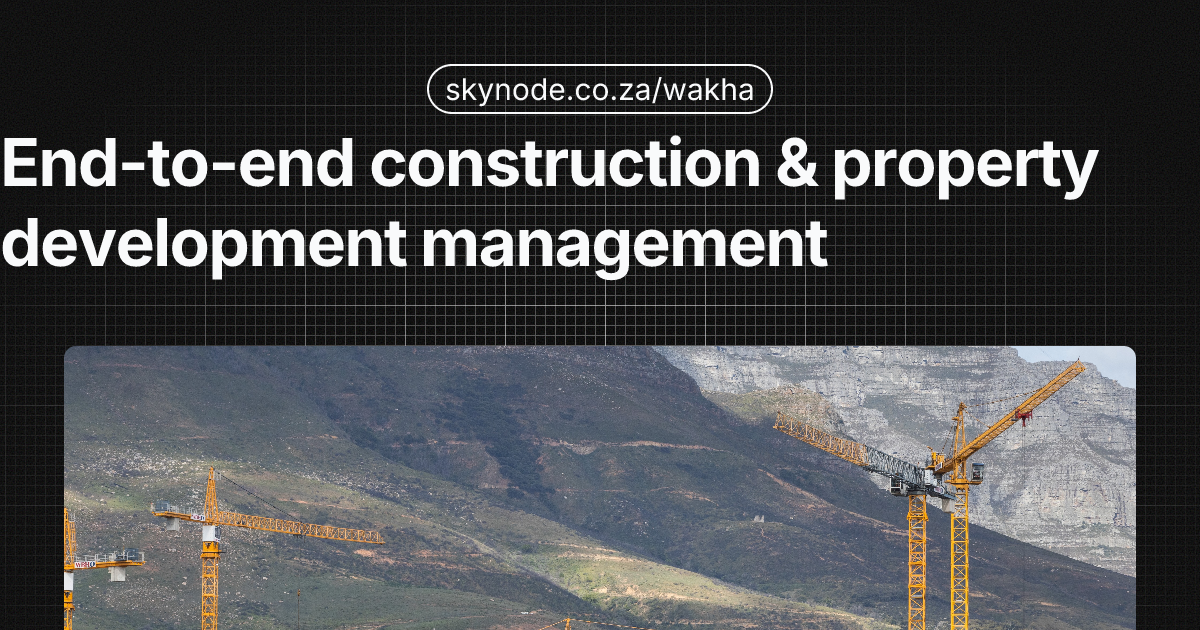
A property developer’s job is widely misunderstood. The developer does not design the building — the architect does. They do not build it — the contractor does. They do not control the cost in detail — the quantity surveyor does. What the developer does is conceive the project, secure the land and the money, assemble and coordinate the team, carry the risk, and make the decisions that keep the whole thing moving towards a profitable conclusion. Property development management is the discipline of doing that well, and it is as much an operating model as a set of tasks.
This guide describes how property developers in South Africa actually run projects — the coordination role at the centre, the gates that keep a development honest, and the systems that hold it all together over a long programme.
The developer at the centre
Every other party on a development reports to their own brief and their own discipline. The developer is the only one accountable for the whole, and that places them at the centre of a web of relationships — with consultants, the contractor, funders, the municipality, buyers — none of whom they directly control. The developer’s leverage is not authority but information and decision-making: knowing the current state of the project across every dimension, and making the right call at the right time.
This is why the developer, more than anyone, depends on a single, current picture of the development. A consultant can afford to know their own slice deeply and the rest vaguely. The developer cannot, because the failures they are accountable for happen in the gaps between the slices.
The dimensions a developer manages
Running a development means holding several dimensions in view at once, each of which can sink a project if neglected.
There is the programme — the sequence and timing of everything from approvals to construction to sales. There is the cost — the budget, the actuals, the variations and the cost-to-complete that determine whether the margin survives. There is the cash flow — the timing of money in and out, the drawdowns, the peak funding requirement that determines whether the project stays solvent. There is compliance — NHBRC, B-BBEE, CIDB and the contract administration that keep the project legal and financeable. And there is the relationship layer — consultants, funders, buyers — whose coordination determines whether decisions reach the people who need them. A developer who manages cost but neglects cash flow, or programme but neglects compliance, has left a gap for the project to fall through.
Governance gates
The most powerful discipline in development management is the gate: a defined point where the project is not allowed to proceed until specific questions are answered. Is the feasibility signed off before the land is committed? Is finance secured before the build starts in earnest? Are the approval conditions satisfied before work proceeds on the approved basis? Is practical completion properly verified before final accounts?
Gates are how a developer stops a drifting project before it commits more money and risk. They turn development from a momentum-driven process, where each stage flows into the next because stopping feels like failure, into a series of deliberate decisions. A developer who runs disciplined gates catches the bad project early, when walking away is merely disappointing rather than ruinous.
The operating rhythm
Beyond the gates, well-run developers operate to a rhythm — a regular cycle of reviewing the same questions across every project. Weekly attention to the site and the immediate programme. Monthly review of cost and cash flow against budget and facility. Deliberate review at each gate. The rhythm is what keeps small problems from becoming large ones, because it catches them while they are still cheap to fix.
The enemy of this rhythm is the effort of gathering the information. When the current state of a project is scattered across consultants, spreadsheets and chats, each review becomes a reconstruction, and the rhythm breaks down under its own weight. When it reads from one source, the review is a matter of looking, and the rhythm sustains itself.
The cost of poor coordination
It is worth being concrete about what poor coordination actually costs, because the failures are easy to underestimate when they are described in the abstract. Consider a few that recur on real developments.
An architect issues a revised drawing that changes a specification, but the quantity surveyor never receives it, so the budget continues to reflect the old design. The overspend is built into the project and only surfaces at a funding report, by which time it is too late to avoid. An engineer flags that a foundation change will move the programme, but the change never reaches the master schedule, so the slip is discovered on site weeks later, with knock-on delays to everything downstream. An approval condition is satisfied late because no one was tracking it, stalling the next stage and adding holding cost. A progress claim is submitted that the funder’s surveyor cannot reconcile against the cost record, delaying the drawdown and leaving the developer funding the gap.
Each of these is a small handover that broke, and individually none looks catastrophic. But on a long programme with many parties, these gaps recur constantly, and their cumulative cost — in overruns, delays, holding cost and strained relationships — is often the difference between a development that hits its margin and one that disappoints. The insight at the heart of development management is that these are not failures of competence by any single party; they are failures of coordination between competent parties, which is precisely what a single, current source of truth is designed to prevent.
The systems that hold it together
This is where the developer’s operating model meets their systems. A developer coordinating a long, multi-dimensional, multi-party project needs one current picture, and the quality of that picture depends on the systems behind it. Wakha is built to be that single record for South African developers — holding the programme, the ZAR budget and cash flow, the site diary, the NHBRC and B-BBEE compliance, the JBCC/NEC/GCC contract administration and payment certificates, and the buyer portal in one place, in 12 South African languages. With one record, the developer’s coordination becomes decision-making rather than detective work, the gates become quick evidenced decisions, and the operating rhythm sustains itself. Wakha is also extending toward early-stage land feasibility, so the developer’s view spans from the appraisal through to handover.
If you are running developments and your operating model is held together by spreadsheets and memory, see how Wakha gives you one current picture: explore Wakha.
Frequently Asked Questions
What does property development management involve?
It involves conceiving a project, securing the land and finance, assembling and coordinating the professional and construction team, carrying the risk, and making the decisions that move the development towards a profitable conclusion. The developer does not design or build — those are the architect’s and contractor’s roles — but coordinates the whole and is accountable for it across programme, cost, cash flow, compliance and relationships.
What is the developer’s main role?
Coordination and decision-making. The developer sits at the centre of a web of parties — consultants, contractor, funders, municipality, buyers — none of whom they directly control, and is the only one accountable for the whole project. Their leverage is having a current picture of the development across every dimension and making the right call at the right time, which is why a single source of truth matters so much to them.
What are governance gates in development?
Gates are defined points where a project cannot proceed until specific questions are answered — feasibility signed off before committing land, finance secured before building, approval conditions satisfied before proceeding, practical completion verified before final accounts. They let a developer stop a drifting project before it commits more money, turning development from momentum-driven into a series of deliberate decisions.
How do developers keep multiple projects on track?
Through an operating rhythm — a regular cycle of reviewing the same questions across every project, typically weekly on the site and programme, monthly on cost and cash flow, and at each gate. Sustaining that rhythm depends on being able to see each project’s current state quickly; when the information is scattered, the rhythm breaks down, which is why portfolio oversight in one system is so valuable.
What is the difference between a developer and a contractor?
The contractor builds the project under a construction contract, responsible for delivering the works. The developer conceives and owns the project, secures the land and finance, coordinates the whole team including the contractor, carries the development risk, and takes the profit or loss. A developer may engage a contractor to build, but the development management role sits above and around the construction.
Do developers need project management software?
A developer coordinating a long, multi-dimensional, multi-party project benefits greatly from a single current record, because their core job is coordination and their failures happen in the gaps between parties. Software that holds programme, cost, cash flow, compliance and relationships together turns coordination into decision-making. The need grows with the scale and number of projects; for a single small job, simpler tools may suffice.
Related Articles:
Ibhalwe ngu
Wakha Team