
Dinyehelo tsa Tlhokomelo tsa OHS Act Afrika Borwa
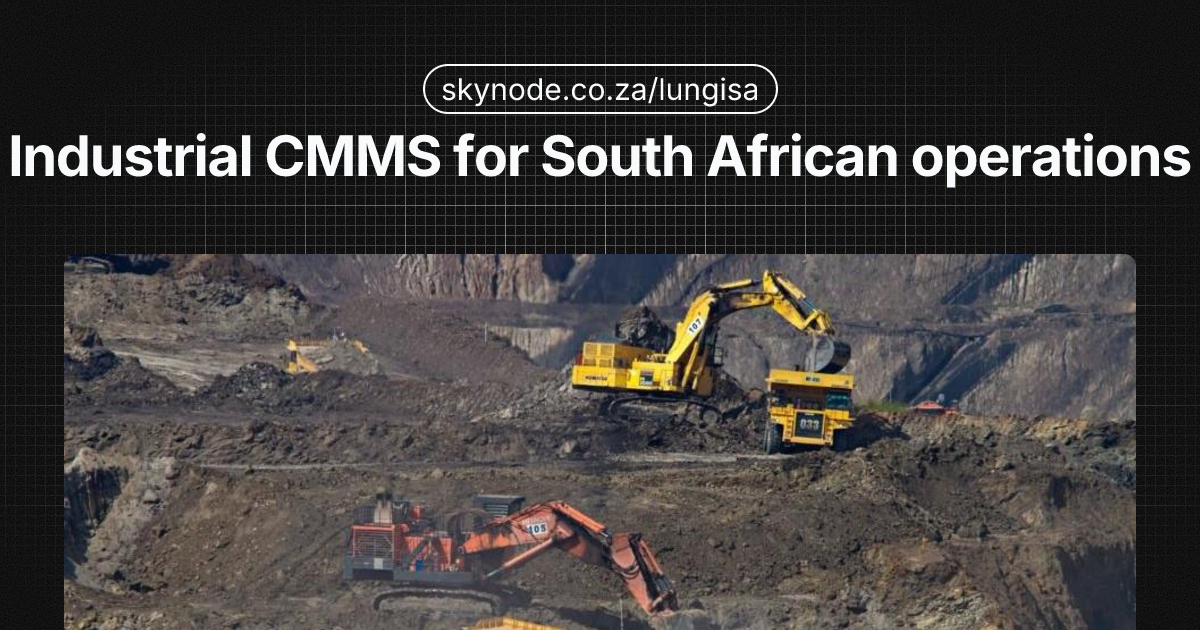
Thepa maemo a arohaneng in a Afrika Borwa factory or feberi/thepa is not only costly in nako e sa sebetseng (often R50,000 or more per hour for a tsoalo line) but can lead to injury, prosecution, and molaudi/ba-audit stoppages. The Occupational Health and Polokeho Act 85 of 1993 (OHS Act) places clear legal duties on moemployeri/baemployeri who operate or maintain feberi/thepa, mesebetsi, or thepa. Tlhokomelo is not optional: the Act and its melao require safe tsamaiso/ditsamaiso of work, regular teko/diteko, and documented tsediso/ditshediso. Sena tataiso sets out the OHS Act tlhokomelo dinyehelo seo apply to you, eng you must keep on file, and how a computerised tlhokomelo tlhokomelo/taolo tsamaiso/ditsamaiso (CMMS) can help you meet them.
The OHS Act is the main law governing workplace health and polokeho in Afrika Borwa. It places duties on moemployeri/baemployeri, self-employed persons, and users of mesebetsi to ensure, so far as is reasonably practicable, seo the working environment is safe and ntle le risk to health. Two sets of melao are especially relevant to tlhokomelo: the General Mesebetsi Melao, 1988 (GMR), e leng govern the use and supervision of mesebetsi, and the Pressure Thepa Melao, 2009 (PER), e leng govern pressure vessels, steam generators, and related thepa. Both impose teko/diteko, testing, and tsediso/ditshediso-keeping duties. In practice, OHS Act tlhokomelo dinyehelo mean reading the Act together le these melao and any approved codes of practice or inspectorate guidance. For meepo-specific duties, bona MHSA tlhokomelo dinyehelo for Afrika Borwa mines.
Section 8: Moemployeri/Baemployeri Duties and Tlhokomelo
Section 8 of the OHS Act sets out the general duties of moemployeri/baemployeri to their employees. It is the foundation for workplace polokeho tlhokomelo dinyehelo.
Safe Feberi/Thepa, Tsamaiso/Ditsamaiso, and Thepa
Every moemployeri/baemployeri must provide and maintain, as far as is reasonably practicable, a working environment seo is safe and ntle le risk to health. In practice sena includes:
- Tsamaiso/Ditsamaiso of work, feberi/thepa and mesebetsi seo are safe and ntle le risks to health.
- Safe arrangements for the tsoalo, processing, use, handling, storage, or transport of articles or substances.
- Thepa and workplaces maintained through regular teko/diteko, servicing, and ho lokisa so seo they remain safe.
Tlhokomelo is therefore a direct consequence of Section 8: thepa and workplaces must be kept in a condition seo does not create risk. Eng is “regular” and eng is “reasonably practicable” depends on the nature of the thepa, the hazards it creates, and the context of use.
Supervision and Information
Section 8 also requires moemployeri/baemployeri to provide such information, instructions, training, and supervision as may be e hlokahalang to ensure the health and polokeho of employees. For tlhokomelo, sena means:
- Ensuring seo persons who perform or supervise tlhokomelo are competent and adequately trained.
- Making sure seo tlhokomelo procedures (including lockout, isolation, and re-commissioning) are clearly communicated and followed.
Hazard Control and “Reasonably Practicable”
Moemployeri/Baemployeri must identify hazards and take steps to eliminate or mitigate them. Personal protective thepa (PPE) is a last resort once engineering and administrative controls (including tlhokomelo) have been applied. “Reasonably practicable” means the degree of effort e hlokahalang is proportionate to the risk. A food feberi/thepa in KZN running pressure vessels and conveyors must have more systematic and frequent tlhokomelo than an office le typical workstations. Courts and molaudi/ba-audit consider eng was known, eng was feasible, and the gravity of potential harm ha assessing tš compliance. In practice, you cannot skip tlhokomelo because it is inconvenient or costly. If mesebetsi could cause serious injury or death if it fails, the law expects a robust tlhokomelo and teko/diteko regime, le tsediso/ditshediso to prove it.
General Mesebetsi Melao: Supervision and Safeguarding
The General Mesebetsi Melao (GMR), published tlasa Government Notice R1521 of 1988, impose detailed duties on moemployeri/baemployeri and users of mesebetsi. They are currently tlasa review; a draft of new General Mesebetsi Melao was published for comment in 2025 (bona below). The following reflects the current GMR and the main themes of the draft.
Designation of a Competent Person
Regulation 2(1) of the GMR requires an moemployeri/baemployeri or user of mesebetsi to designate in writing a person in a full-time capacity for every premises moo mesebetsi is used, to ensure tš compliance le the Act and the GMR. Seo person must be a competent person as defined in the melao. The Chief Molaudi/Ba-audit may allow more than one person to be designated, or permit designation of someone le other qualifications tlasa conditions.
Tlasa the current GMR, a “competent person” in relation to mesebetsi includes persons who have served an apprenticeship (or had at least five years’ practical experience) in the operation and tlhokomelo of mesebetsi, plus at least one year’s experience appropriate to the class of mesebetsi they supervise; persons le an engineering diploma (e.g. mechanical or electrotechnical at T3/N5 level) and two years’ practical experience; graduate engineers le two years’ post-graduate experience and a pass in the prescribed examination; or certificated engineers. Higher power thresholds (e.g. over 1200 kW or 3000 kW) require the designated person to hold higher-level qualifications.
GMR 2025 Draft: Competent Person and Scope
The Department of Employment and Labour published draft General Mesebetsi Melao in 2025 for public comment (Government Notice 53210 of 22 August 2025). Key proposed changes relevant to tlhokomelo and supervision include:
- Competent person definition: The draft updates the definition to include persons who have successfully completed an apprenticeship or accredited learnership in an engineering trade seo included the operation and tlhokomelo of mesebetsi, or who have at least five years’ practical experience. Sena formally brings learnerships in line le apprenticeships. The draft also removes the “graduate engineer” route from the definition in its current form, narrowing the routes to competency.
- Full-time competent person per premises: The draft reinforces the nyehelo/dinyehelo for a full-time designated competent person per premises moo mesebetsi is used, emphasising seo supervision of mesebetsi must be resourced on a dedicated basis.
- Extended mesebetsi scope: The draft broadens the range of mesebetsi and thepa covered, e leng may bring more thepa tlasa teko/diteko and tlhokomelo obligations.
Moemployeri/Baemployeri should monitor the finalisation of these melao and align tlhokomelo and staffing le the updated definitions and scope once promulgated. For eng is changing, bona the General Mesebetsi Melao 2025 draft and ho etsa jwang prepare.
Safeguarding and Operation
GMR Regulation 3 requires moemployeri/baemployeri and users to ensure seo mesebetsi is suitable, installed, operated, and maintained so as to prevent exposure to hazardous or potentially hazardous conditions; seo dangerous parts are effectively safeguarded; and seo polokeho thepa is kept in good working order and properly used. Regulation 4 deals le operation: operators must be aware of dangers and precautionary measures, and mesebetsi seo requires constant attention must be tlasa the supervision of a shiftsman who is present while it is in operation. Tlhokomelo plans and tsediso/ditshediso support tš compliance by demonstrating seo thepa is kept in a safe condition and seo supervision is informed by up-to-date thepa status.
Pressure Thepa Dinyehelo
Pressure thepa (pressure vessels, steam generators, piping, and associated fittings) is governed by the Pressure Thepa Melao, 2009 (PER), tlasa the OHS Act. Users must ensure seo pressure thepa is inspected and tested pele commissioning and at specified nako/dinako thereafter.
- Initial teko/diteko and testing: Pele commissioning, thepa must be inspected and tested in line le the PER (e.g. witnessed internal and external teko/diteko and hydraulic pressure tests by an approved teko/diteko authority, unless the regulation provides otherwise).
- In-service nako/dinako: Fire-tube steam generators generally require external teko/diteko every 12 months and witnessed hydraulic testing and crack detection every 36 months. Other pressure vessels and steam generators have their own nako/dinako tlasa the PER.
- Ho lokisa and modifications: PER Regulation 13 requires seo ho lokisa and modifications be properly assessed and documented so seo the integrity of the pressure thepa is not compromised. All work must align le manufacturer specifications and applicable standards.
These pressure thepa dinyehelo are part of the overall OHS Act tlhokomelo dinyehelo: they define minimum teko/diteko and testing frequencies and the need for documented bopaki of tš compliance.
Tlhokomelo Tsediso/Ditshediso-Keeping Obligations
Tlasa the OHS Act and its melao, moemployeri/baemployeri and users of mesebetsi must keep tsediso/ditshediso seo demonstrate tš compliance. Although the exact wording differs between the GMR and the PER, the following are commonly e hlokahalang or expected:
- Performance tests and examinations: Tsediso/Ditshediso of ha tests and examinations were done, by whom, and the outcome (e.g. pass/fail, conditions imposed). For pressure thepa, the PER requires seo these be documented in line le Regulation 14.
- Modifications and ho lokisa: A tsediso/ditshediso of any modifications or ho lokisa to mesebetsi or pressure thepa, including eng was done and ha, so seo the history of the thepa is traceable. PER Regulation 13 ties ho lokisa and modifications to documented assessment and integrity.
- Register on premises: The GMR framework and related practice often expect a register (or equivalent) of mesebetsi and/or pressure thepa to be kept on the premises, le particulars of tests, examinations, and ho lokisa, and to be available for teko/diteko by an molaudi/ba-audit ha requested.
Eng Moemployeri/Baemployeri Should Retain in Practice
In practice, moemployeri/baemployeri should retain for each relevant thepa or tsamaiso/ditsamaiso: the identity and location of the thepa; the date and type of each teko/diteko, test, or service; the name and capacity of the person who performed or witnessed it (e.g. competent person, approved teko/diteko authority); the result (e.g. passed, failed, conditions or limitations); and any defects found and remedial action taken. For pressure thepa, certificates or phuputso/liphuputso from approved teko/diteko authorities should be kept le the thepa tsediso/ditshediso. Tsediso/Ditshediso may be kept in hard copy or electronically, but they must be retrievable and legible ha an molaudi/ba-audit or auditor asks to bona them. PER Regulation 14 explicitly sets out tsediso/ditshediso-keeping dinyehelo for pressure thepa. Keeping these tsediso/ditshediso in one place, le clear dates and responsible persons, is essential for proving tš compliance during an audit or molaudi/ba-audit visit.
Teko/Diteko Scheduling Dinyehelo
Teko/Diteko and testing must be thulaganyo/reriloe so seo they occur at the nako/dinako e hlokahalang by law and by the manufacturer or applicable standards. Key nako/dinako tlasa Afrika Borwa melao include:
| Thepa or tsamaiso/ditsamaiso | Teko/Diteko / test | Maximum nako/dinako |
|---|---|---|
| Lifting mesebetsi (full examination) | Comprehensive examination and performance testing | 12 months |
| Lifting mesebetsi (ropes, chains, hooks, sheaves, brakes, polokeho devices) | Examination | 6 months |
| Fire-tube steam generators | External teko/diteko | 12 months |
| Fire-tube steam generators | Witnessed hydraulic test and crack detection | 36 months |
| Other pressure vessels and steam generators | As per PER and applicable approval | Per PER / standard |
For general mesebetsi tlasa the GMR, the obligation is to maintain thepa so seo it does not expose persons to hazard. Seo implies a risk-based approach: higher-risk or e bohlokwa thepa should have more frequent teko/diteko and servicing, documented in a thulaganyo/reriloe. Manufacturer manuals and any applicable Afrika Borwa National Standards (SANS) or industry codes may specify additional nako/dinako; these should be incorporated into your tlhokomelo thulaganyo/reriloe. A CMMS can hold these nako/dinako and generate taelo/taelo ya mosebetsi so seo nothing is missed, and can flag overdue tasks for immediate attention.
Penalties for Non-Tš compliance
Non-tš compliance le the OHS Act and melao can result in enforcement action and serious consequences.
- GMR offences: Contravention of specified provisions of the GMR (including designation of a competent person, safeguarding, operation, and related notices) can lead to a fine or imprisonment (tlasa the current melao, up to R1,000 or six months, le letsatsi le letsatsi penalties for continuing offences). Note seo amendment bills and administrative penalty regimes may increase these amounts.
- Administrative fines: Amendments to the OHS Act introduce the possibility of administrative fines issued by molaudi/ba-audit for health and polokeho violations, e leng can be significant and can be applied per instance of non-tš compliance.
- Criminal prosecution: In serious cases, including moo negligence leads to injury or death, moemployeri/baemployeri and responsible persons may face criminal prosecution. Penalties can include larger fines and imprisonment; fatalities can lead to charges such as culpable homicide le severe sentences.
Maemo a arohaneng to maintain thepa, keep tsediso/ditshediso, or thulaganyo/reriloe teko/diteko can be cited as part of a breach of Section 8 or the melao. Maintaining a clear audit trail of tlhokomelo and teko/diteko helps show seo you have taken reasonably practicable steps to comply. Proactive tsediso/ditshediso-keeping also speeds up responses during an incident investigation or an molaudi/ba-audit’s visit, ha you may be asked to produce bopaki of recent teko/diteko and tlhokomelo for the thepa involved.
How a CMMS Supports OHS Act Tš compliance
A computerised tlhokomelo tlhokomelo/taolo tsamaiso/ditsamaiso (CMMS) does not replace your legal obligations, but it can help you meet them consistently and prove it to molaudi/ba-audit and auditors.
Template/Ditemplate and Standard Procedures
A CMMS can store standard job plans and checklists for teko/diteko and tests e hlokahalang by the GMR, PER, and your own risk assessments. Template/Ditemplate ensure seo the same steps are followed every time (e.g. lockout, teko/diteko points, pass/fail criteria) and seo nothing is omitted. Sena supports both Section 8 (safe tsamaiso/ditsamaiso of work) and regulation-specific dinyehelo.
Scheduling and Nako/Dinako
OHS Act tlhokomelo dinyehelo and the PER impose fixed nako/dinako (e.g. 6 months, 12 months, 36 months). A CMMS can define these nako/dinako per thepa or thepa type and generate taelo/taelo ya mosebetsi automatically ha due. Sena reduces the risk of missed teko/diteko and helps you demonstrate seo teko/diteko are thulaganyo/reriloe and performed on time.
Audit Trail and Tsediso/Ditshediso
Molaudi/Ba-audit and auditors expect to bona tsediso/ditshediso of eng was done, ha, and by whom. A CMMS seo tsediso/ditshediso completed taelo/taelo ya mosebetsi, findings, and follow-up actions provides a single place for tlhokomelo and teko/diteko history. If the tsamaiso/ditsamaiso supports attachments (e.g. teko/diteko phuputso/liphuputso, certificates), you can link them to the thepa and the taelo/taelo ya mosebetsi, making it easier to produce bopaki during an teko/diteko or audit.
Digital Sign-Off and Competent Persons
Moo work must be performed or approved by a competent person, a CMMS can tsediso/ditshediso who performed or signed off the task. Seo supports the GMR nyehelo/dinyehelo for a designated competent person and helps you show seo teko/diteko and tlhokomelo were carried out by authorised, qualified personnel.
Meeting OHS Act tlhokomelo dinyehelo means scheduling teko/diteko on time, keeping a clear audit trail, and producing tsediso/ditshediso ha an molaudi/ba-audit or auditor asks. Bona how Lungisa helps Afrika Borwa ditshebetso stay audit-ready le thulaganyo/reriloe teko/diteko, competent-person sign-off, and one tsamaiso/ditsamaiso of tsediso/ditshediso for meepo, thepa, and thepa.
Sena tatelano is for general information only and does not constitute legal advice. Tlhokomelo and teko/diteko obligations depend on your specific mesebetsi, pressure thepa, and circumstances. For advice on your duties tlasa the OHS Act and melao, consult a qualified legal or health and polokeho professional.
E ngotsweng ke
Lungisa Team