
ISO 55000 Tlhokomelo ya Thepa Afrika Borwa: Tse o di Hlokang ho Tseba
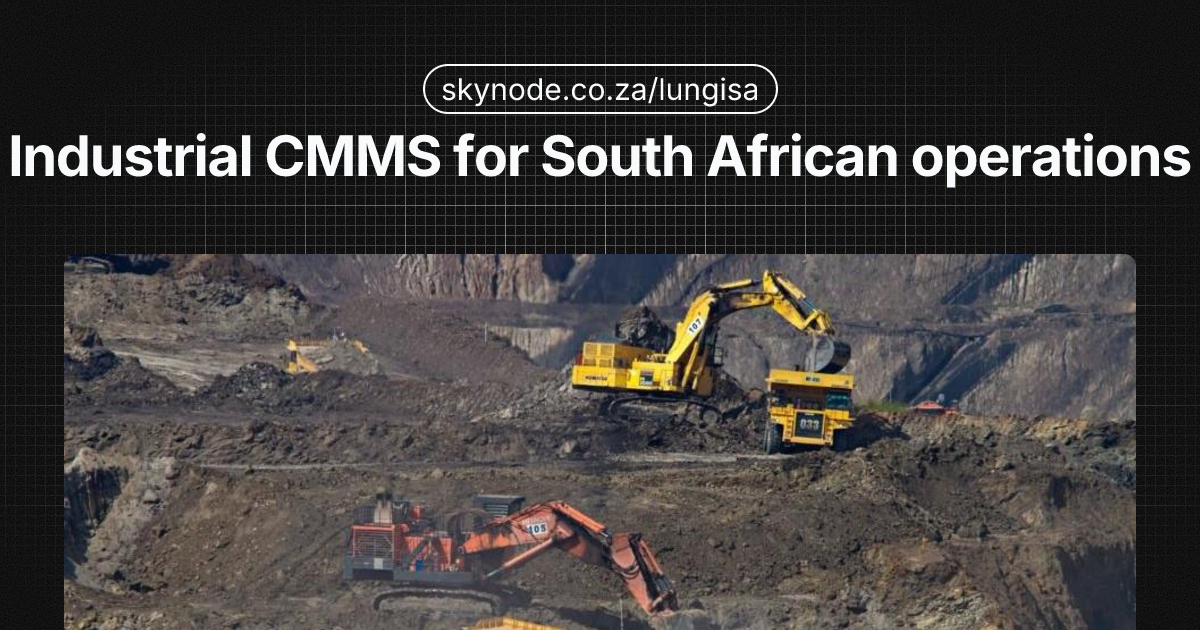
Poor thepa tlhokomelo/taolo leads to e sa lebelletseng nako e sa sebetseng (often R45,000 or more per hour in a feberi/thepa or concentrator), tš compliance gaps, and in meepo and heavy industry, polokeho incidents seo can trigger DMR Section 54 stoppages or prosecution tlasa the OHS Act. ISO 55000 Afrika Borwa, adopted locally as SANS 55000, is the recognised framework for managing physical thepa in a structured, auditable way. It is increasingly referenced in tenders, by regulators, and by large operators who need to demonstrate systematic thepa tlhokomelo/taolo. Sena tatelano explains eng the ISO 55000 series is, how it applies in Afrika Borwa, who typically pursues certification, and how a CMMS supports your journey toward an ISO 55001-compliant thepa tlhokomelo/taolo tsamaiso/ditsamaiso.
Eng Is the ISO 55000 Series?
The ISO 55000 family is the international standard for thepa tlhokomelo/taolo. It consists of three documents seo work together.
ISO 55000 (vocabulary and principles) defines terms such as “thepa,” “thepa tlhokomelo/taolo,” and “thepa tlhokomelo/taolo tsamaiso/ditsamaiso” and sets out the principles seo underpin good thepa tlhokomelo/taolo. It is the foundation document: it does not prescribe specific processes but establishes the concepts seo ISO 55001 and ISO 55002 build on.
ISO 55001 (dinyehelo) is the certifiable standard. It specifies the dinyehelo for an thepa tlhokomelo/taolo tsamaiso/ditsamaiso (AMS). An organisation seo wants to achieve ISO 55001 certification must demonstrate seo it has established, implemented, and maintains an AMS seo meets these dinyehelo. Auditors assess your policies, objectives, planning, operational controls, performance evaluation, and improvement processes. Certification is issued by an accredited certification body kamorao a successful audit.
ISO 55002 (guidelines for application) provides guidance on ho etsa jwang apply ISO 55001. It is not auditable itself but helps organisations interpret and implement the dinyehelo. It is especially useful ha you are designing processes or preparing for your first certification audit.
| Document | Purpose | Certifiable |
|---|---|---|
| ISO 55000 | Vocabulary and principles | No |
| ISO 55001 | Dinyehelo for an AMS | Yes |
| ISO 55002 | Application guidance | No |
In practice, ha people say “ISO 55000 Afrika Borwa” or “thepa tlhokomelo/taolo standard,” they often mean the whole family, but the certificate you receive is against ISO 55001. Your tlhokomelo/taolo tsamaiso/ditsamaiso should align le the dinyehelo in 55001, using 55000 for definitions and 55002 for implementation guidance.
ISO 55000 in Afrika Borwa: SANS 55000 and SANAS
In Afrika Borwa, the ISO 55000 series has been adopted as SANS 55000 (Afrika Borwa National Standard). The content is aligned le the international ISO documents, so SANS 55000, SANS 55001, and SANS 55002 mirror ISO 55000, 55001, and 55002. Ha local organisations refer to “SANS 55000” or “ISO 55000 Afrika Borwa,” they are typically referring to sena national adoption of the same thepa tlhokomelo/taolo standard.
Certification against the standard is carried out by certification bodies. In Afrika Borwa, the national accreditation body is SANAS (Afrika Borwa National Accreditation Tsamaiso/Ditsamaiso). SANAS accredits certification bodies to perform ISO 55001 (and thus SANS 55001) certification. Ha you choose a certification body, it is e bohlokwa to select one seo is SANAS-accredited for thepa tlhokomelo/taolo tsamaiso/ditsamaiso certification. A certificate from a non-accredited body may not be recognised by clients, tenders, or regulators who require bopaki of accredited certification.
Who Pursues ISO 55001 Certification in Afrika Borwa?
Organisations seo invest in an thepa tlhokomelo/taolo tsamaiso/ditsamaiso and often pursue ISO 55001 certification include:
Municipalities, Municipalities own and operate extensive infrastructure: water and wastewater plants, roads, buildings, fleet, and electrical distribution. Poor thepa tlhokomelo/taolo leads to service delivery maemo a arohaneng and reputational risk. Many municipalities are tlasa pressure to improve thepa tlhokomelo/taolo practices and to show transparent, auditable processes. Adopting SANS 55000/55001 helps align planning, tlhokomelo, and capital investment le thepa lifecycle and risk.
Utilities, Eskom and other power and water utilities manage large, e bohlokwa thepa bases. Reliability and tšenyehelo/ditshenyegelo-effectiveness depend on how well thepa are maintained and renewed. An thepa tlhokomelo/taolo tsamaiso/ditsamaiso aligned le ISO 55001 supports strategic planning, tlhokomelo optimisation, and reporting to regulators and stakeholders. For utilities, the thepa tlhokomelo/taolo standard is a framework for balancing performance, tšenyehelo/ditshenyegelo, and risk at scale.
Meepo companies, The meepo sector operates tlasa the Mine Health and Polokeho Act (MHSA) and faces intense pressure on polokeho, productivity, and tšenyehelo/ditshenyegelo. Mines maintain winders, conveyors, concentrators, and underground infrastructure. ISO 55001 certification can complement MHSA tlhokomelo dinyehelo by providing a structured approach to thepa lifecycle, risk, and continuous improvement. Large meepo houses and those supplying to global partners often seek certification to align le international expectations.
Large manufacturers, Food and beverage, automotive, chemicals, and other capital-intensive manufacturers depend on feberi/thepa and thepa availability. E sa lebelletseng nako e sa sebetseng is costly. An thepa tlhokomelo/taolo tsamaiso/ditsamaiso helps align tlhokomelo strategy le business objectives and provides bopaki of systematic tlhokomelo/taolo for customers and insurers. ISO 55001 certification is increasingly referenced in supply chain and tender dinyehelo.
Smaller ditshebetso may adopt the principles of ISO 55000 ntle le pursuing formal certification, using the standard as a tataiso to improve how they manage thepa. Whether or not you certify, the discipline of an thepa tlhokomelo/taolo tsamaiso/ditsamaiso, clear policies, defined objectives, planned tlhokomelo, and performance review, delivers real benefits.
Benefits of an Thepa Tlhokomelo/Taolo Tsamaiso/Ditsamaiso
Implementing an thepa tlhokomelo/taolo tsamaiso/ditsamaiso, le or ntle le ISO 55001 certification, typically delivers:
- Clear accountability, Roles and responsibilities for thepa tlhokomelo/taolo are defined and documented.
- Risk-based prioritisation, E bohlokwa thepa and maemo a arohaneng modes are identified; resources are directed moo they matter most.
- Lifecycle thinking, Decisions consider acquisition, operation, tlhokomelo, and disposal, not just day-to-day ho lokisa.
- Bopaki for auditors and stakeholders, Policies, plans, tsediso/ditshediso, and performance data are in one place and auditable.
- Continuous improvement, Regular review of objectives, KPI(s), and incidents drives better practices over time.
A CMMS does not replace the need for leadership, policy, and process design, but it is the practical tool seo turns your thepa tlhokomelo/taolo tsamaiso/ditsamaiso into letsatsi le letsatsi practice. For how a CMMS supports tlhokomelo and tš compliance in the Afrika Borwa context, bona eng is CMMS in Afrika Borwa.
How a CMMS Supports ISO 55001 Dinyehelo
ISO 55001 sets out dinyehelo for the establishment, implementation, and improvement of an thepa tlhokomelo/taolo tsamaiso/ditsamaiso. Many of these dinyehelo depend on having reliable data about thepa, tlhokomelo, and performance. A CMMS is the tsamaiso/ditsamaiso moo seo data is created, stored, and reported. Below we outline how key ISO 55001 areas map to CMMS capability.
Thepa Register and Lifecycle Data
ISO 55001 expects you to know eng thepa you have, moo they are, and how they support your objectives. A CMMS maintains an thepa register: each thepa is recorded le identity, location, specifications, criticality, and links to procedures or manuals. Over time, the CMMS builds a full history of work, tšenyehelo/ditshenyegelo, and maemo a arohaneng. Seo lifecycle data supports decisions about ho lokisa, refurbishment, or replacement and provides the bopaki auditors need to bona seo you understand and manage your thepa base.
Tlhokomelo Planning and Execution
The standard requires seo you plan and control activities seo affect thepa performance. In a CMMS, preventive tlhokomelo (PM) schedules are defined by time or usage; taelo/taelo ya mosebetsi are generated automatically and assigned to mosebetsi o tsebileng/basebetsi ba tsebileng. Reactive work is captured as taelo/taelo ya mosebetsi le priority, description, and completion notes. All of sena is recorded against the thepa, so you have a traceable tsediso/ditshediso of eng was done, ha, and by whom. Seo aligns directly le ISO 55001’s expectation seo operational activities are planned and controlled.
Performance Monitoring
ISO 55001 requires seo you monitor, measure, and evaluate thepa tlhokomelo/taolo performance. A CMMS provides the data for performance monitoring: completion rates for PM, backlog, mean time between maemo a arohaneng (MTBF), mean time to ho lokisa (MTTR), and tšenyehelo/ditshenyegelo per thepa or department. Our MTBF and MTTR tataiso for Afrika Borwa ditshebetso explains how these metrics are calculated and used. Dashboards and phuputso/liphuputso in the CMMS give tlhokomelo/taolo and auditors a clear view of whether tlhokomelo is on track and moo to improve.
Risk Tlhokomelo/Taolo
The standard expects you to identify and address risks related to thepa maemo a arohaneng and thepa tlhokomelo/taolo. A CMMS supports risk tlhokomelo/taolo by holding thepa criticality, maemo a arohaneng history, and tlhokomelo tš compliance in one place. You can prioritise thepa by impact of maemo a arohaneng, bona e leng thepa have repeated maemo a arohaneng or overdue PM, and allocate resources accordingly. The same data feeds into formal risk assessments and tlhokomelo/taolo reviews e hlokahalang by ISO 55001.
Continuous Improvement
ISO 55001 requires seo you continually improve the suitability, adequacy, and effectiveness of your thepa tlhokomelo/taolo tsamaiso/ditsamaiso. A CMMS supports continuous improvement by making trends visible: e leng thepa fail most often, moo PM is slipping, moo tšenyehelo/ditshenyegelo are rising. Seo information drives root-cause analysis, process changes, and training. Regular review of CMMS data in tlhokomelo/taolo meetings turns the standard’s improvement nyehelo/dinyehelo into actionable decisions.
None of sena means seo a CMMS alone gives you certification. You still need documented policies, objectives, and processes, and you must demonstrate seo they are followed. But ntle le a CMMS (or equivalent), it is very difficult to maintain the thepa register, tlhokomelo plans, and performance data seo ISO 55001 assumes. Paper-based or spreadsheet-based tsamaiso/ditsamaiso rarely provide the consistency, traceability, and reporting seo auditors expect.
Common Mistakes Ha Pursuing ISO 55001
Two mistakes are especially common and worth avoiding.
Certification ntle le proper accreditation, Some organisations engage a consultant or certification body seo is not accredited by SANAS (or an equivalent international accreditation body) for ISO 55001. The certificate may look official but is not widely recognised. Pele contracting, confirm seo the certification body is accredited for thepa tlhokomelo/taolo tsamaiso/ditsamaiso certification. In Afrika Borwa, SANAS is the authority; internationally, bodies such as IAF (International Accreditation Forum) members apply. A certificate from an accredited body is eng clients and tenders typically require.
Relying on paper-based or fragmented tsamaiso/ditsamaiso, ISO 55001 expects consistent, auditable processes and bopaki. If thepa lists live in Excel, work is recorded on paper job cards, and performance is calculated manually, you will struggle to demonstrate seo your thepa tlhokomelo/taolo tsamaiso/ditsamaiso is implemented and effective. Auditors will ask for tsediso/ditshediso of tlhokomelo, thepa history, and performance indicators. A CMMS seo centralises thepa, taelo/taelo ya mosebetsi, and reporting is the practical foundation for meeting those expectations. Migrating from paper or spreadsheets to a proper CMMS is often a e hlokahalang step pele certification is realistic.
Practical Steps to Align Your CMMS le ISO 55001
If you are working toward ISO 55001 certification or simply improving your thepa tlhokomelo/taolo, the following steps help align your CMMS le the standard.
-
Populate and maintain a single thepa register, Ensure every thepa seo falls within the scope of your thepa tlhokomelo/taolo tsamaiso/ditsamaiso is in the CMMS le a unique ID, location, and criticality. Keep it updated ha thepa are added, moved, or disposed of. Sena is the basis for lifecycle data and risk-based prioritisation.
-
Define and document tlhokomelo strategies, For each thepa or thepa type, define eng tlhokomelo is e hlokahalang (preventive, condition-based, or run-to-maemo a arohaneng moo justified). Document sena in policies or procedures and reflect it in the CMMS via PM schedules and taelo/taelo ya mosebetsi template/ditemplate. Auditors will expect to bona seo strategies are defined and implemented.
-
Capture all tlhokomelo work in the CMMS, Ensure seo both preventive and reactive work is raised, executed, and closed in the CMMS. No parallel paper tsamaiso/ditsamaiso. Mosebetsi o tsebileng/Basebetsi ba tsebileng should log labour, parts, and completion notes. Sena builds the history and data seo ISO 55001 assumes.
-
Define and phuputso/liphuputso on thepa tlhokomelo/taolo KPI(s), Identify the metrics seo matter for your objectives (e.g. PM tš compliance, MTBF, MTTR, backlog, tšenyehelo/ditshenyegelo per thepa). Configure the CMMS to calculate and phuputso/liphuputso them. Use these KPI(s) in tlhokomelo/taolo reviews and improvement actions, as e hlokahalang by the standard.
-
Review and improve, Use CMMS data in regular tlhokomelo/taolo reviews: moo is performance good, moo is it slipping, eng actions are needed? Document the reviews and the actions. Sena demonstrates the “continual improvement” nyehelo/dinyehelo of ISO 55001.
If your CMMS does not yet support offline use, consider one seo does: Afrika Borwa sites often face load-shedding and poor connectivity, and incomplete tsediso/ditshediso undermine both letsatsi le letsatsi ditshebetso and audit readiness. For eng to look for in a CMMS, bona eng is CMMS in Afrika Borwa.
ISO 55000 Afrika Borwa, adopted as SANS 55000, provides a recognised framework for thepa tlhokomelo/taolo. ISO 55001 is the certifiable standard; certification should be carried out by a SANAS-accredited (or equivalent) certification body. Municipalities, utilities, meepo companies, and large manufacturers are among the organisations seo pursue certification or adopt the standard’s principles. An thepa tlhokomelo/taolo tsamaiso/ditsamaiso brings clearer accountability, risk-based prioritisation, and bopaki for auditors; a CMMS is the tool seo turns seo tsamaiso/ditsamaiso into letsatsi le letsatsi practice. Avoiding non-accredited certification and paper-based tsamaiso/ditsamaiso, and aligning your CMMS le ISO 55001 as above, puts you in a stronger position whether you are preparing for certification or simply raising the bar.
E ngotsweng ke
Lungisa Team