
Template ya Thulaganyo ya Tlhokomelo e Thibang Afrika Borwa
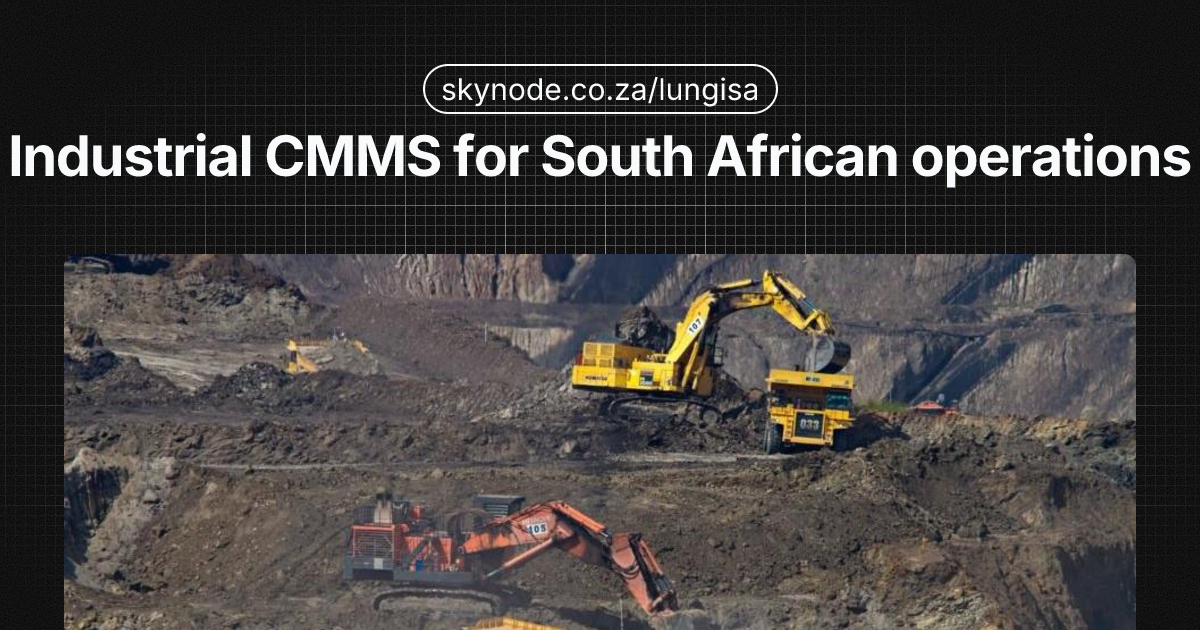
E sa lebelletseng maemo a arohaneng tšenyehelo/ditshenyegelo Afrika Borwa ditshebetso thousands of rand per hour in lost tsoalo, and missed statutory teko/diteko can trigger DMR stoppages or OHS Act enforcement. A preventive tlhokomelo thulaganyo/reriloe template/ditemplate is the first step away from reactive firefighting: it forces you to define eng must be maintained, how often, and by whom. Whether you run a mine, a factory, or a commercial building, having a single view of due tasks reduces maemo a arohaneng and helps you prove tš compliance to molaudi/ba-audit and insurers. Sena tatelano provides a ready-to-use preventive tlhokomelo thulaganyo/reriloe template/ditemplate in table form, sample rows for common local thepa, guidance on OHS Act and GMR teko/diteko nako/dinako, and ho etsa jwang adapt it for your site. It also explains moo a spreadsheet stops scaling and ha a CMMS becomes e hlokahalang.
Eng a Preventive Tlhokomelo Thulaganyo/Reriloe Template/Ditemplate Should Include
A useful preventive tlhokomelo thulaganyo/reriloe template/ditemplate does three things: it lists eng must be done, ha it is due, and who does it. It should also flag any tasks seo are e hlokahalang by law or by your insurer so you can prioritise and prove tš compliance.
At minimum, your template/ditemplate should capture:
- Thepa or thepa, The item being maintained (e.g. generator, conveyor, HVAC unit).
- Location, Moo the thepa is (building, area, or site). Essential for multi-site or large thepa.
- PM task, The specific activity (teko/diteko, lubrication, test, replacement).
- Frequency, How often the task is due (letsatsi le letsatsi, beke le beke, kgweding le kgweding, kgweding e nngwe le e nngwe, selemo le selemo, or by running hours/meters).
- Assigned to, The person or role responsible for performing or supervising the work.
- Last completed, Date (or meter reading) ha the task was last done.
- Next due, Date or trigger ha the task is next due.
- Tš compliance nyehelo/dinyehelo, Whether the task is statutory (OHS Act, pressure thepa, fire, lift) or internal.
Ntle le these fields, you cannot reliably plan work, assign it, or demonstrate to an molaudi/ba-audit seo tlhokomelo is tlasa control. The tables below provide a structure you can copy into Excel or Google Sheets and fill le your own thepa and tasks.
Template/Ditemplate Structure
Use the following table as your core preventive tlhokomelo thulaganyo/reriloe template/ditemplate. Add or remove columns to suit your operation (for example “Estimated duration,” “Ditho tsa spare,” or “Checklist reference”), but keep at least these eight so you can track assignments and due dates.
| Thepa | Location | PM Task | Frequency | Assigned To | Last Completed | Next Due | Tš compliance Req |
|---|---|---|---|---|---|---|---|
| [Thepa name or ID] | [Building/area/site] | [Task description] | [e.g. Beke le beke] | [Name or role] | [Date] | [Date] | [Statutory / Internal / None] |
Copy sena header and add one row per PM task. If one thepa has multiple tasks at different frequencies (e.g. letsatsi le letsatsi checks and annual overhaul), use one row per task so each has its own “Next due” and “Assigned to.”
Sample Data for Common Afrika Borwa Thepa
The table below shows example rows for thepa commonly found in Afrika Borwa meepo, thepa, and thepa. Frequencies are indicative; adjust them to your OEM manuals, risk assessments, and any OHS Act tlhokomelo dinyehelo seo apply. Use these as a starting point and expand le your own thepa.
| Thepa | Location | PM Task | Frequency | Assigned To | Last Completed | Next Due | Tš compliance Req |
|---|---|---|---|---|---|---|---|
| Standby generator G-01 | Main feberi/thepa, electrical room | Visual teko/diteko; check fuel, oil, coolant; run test | Beke le beke | Electrical tech | 2026-01-21 | 2026-01-28 | Internal |
| Standby generator G-01 | Main feberi/thepa, electrical room | Load test; battery check; service per OEM | Kgweding le kgweding | Electrical tech | 2025-12-15 | 2026-01-15 | Internal |
| Air compressor AC-01 | Workshop A | Drain condensate; check oil level; inspect belts | Letsatsi le letsatsi | Workshop lead | 2026-01-27 | 2026-01-28 | Internal |
| Air compressor AC-01 | Workshop A | Full service; filter replacement; pressure test | Kgweding e nngwe le e nngwe | Fitter | 2025-10-01 | 2026-01-01 | Internal |
| HVAC unit AHU-01 | Admin block, roof | Filter replacement; coil teko/diteko; drain check | Kgweding le kgweding | Thepa | 2025-12-28 | 2026-01-28 | Internal |
| Fire extinguishers (block A) | Block A, all floors | Visual teko/diteko; pressure gauge; accessibility | Kgweding le kgweding | Polokeho rep | 2026-01-01 | 2026-02-01 | Statutory (fire) |
| Fire panel & detection | Building-wide | Test detection zones; alarm test; log results | Kgweding le kgweding | Fire moebedi/baebedi / Thepa | 2025-12-15 | 2026-01-15 | Statutory (fire) |
| Passenger lift L1 | Main tower | General teko/diteko; door polokeho; levelling | Kgweding le kgweding | Lift moebedi/baebedi | 2025-12-20 | 2026-01-20 | Statutory (lift) |
| Passenger lift L1 | Main tower | Annual thorough examination & test | Selemo le selemo | Approved body | 2025-06-01 | 2026-06-01 | Statutory (lift) |
| Conveyor C-01 | Feberi/Thepa, line 1 | Belt alignment; idler check; lubrication | Beke le beke | Mechanical | 2026-01-22 | 2026-01-29 | Internal |
| Conveyor C-01 | Feberi/Thepa, line 1 | Drive guard; emergency stop test; guarding check | Kgweding le kgweding | Mechanical | 2025-12-28 | 2026-01-28 | OHS / GMR |
| Forklift FL-03 | Warehouse | Pre-use check; fluid levels; tyres; brakes | Letsatsi le letsatsi | Operator / Stores | 2026-01-27 | 2026-01-28 | Internal |
| Forklift FL-03 | Warehouse | Lifting thepa teko/diteko (thorough exam) | Every 6 months | Competent person | 2025-08-01 | 2026-02-01 | Statutory (lifting) |
These examples illustrate the mix of routine PM (letsatsi le letsatsi, beke le beke, kgweding le kgweding) and less frequent statutory or OEM-driven tasks. For a strategic view of ha to use planned versus run-to-maemo a arohaneng approaches, bona preventive vs reactive tlhokomelo in the Afrika Borwa context.
OHS Act and E hlokahalang Teko/Diteko Nako/Dinako
Afrika Borwa law does not prescribe a single “tlhokomelo thulaganyo/reriloe template/ditemplate” for all thepa. It does, however, require moemployeri/baemployeri to maintain feberi/thepa and thepa and to keep tsediso/ditshediso. Several melao specify minimum teko/diteko or examination nako/dinako for certain classes of thepa. Your PM thulaganyo/reriloe template/ditemplate should align le these so seo statutory tasks are clearly marked and never missed.
Mesebetsi (General Mesebetsi Melao)
Tlasa the General Mesebetsi Melao, mesebetsi must be maintained and supervised by a competent person. The melao do not list every nako/dinako for every machine; they require seo mesebetsi is kept in a safe condition and seo teko/diteko and tlhokomelo are carried out as e hlokahalang. In practice, you define nako/dinako from OEM guidance, risk assessment, and industry practice, and you document them. High-risk or high-power mesebetsi typically needs formal teko/diteko and tsediso/ditshediso-keeping; your template/ditemplate’s “Tš compliance Req” column should flag these as statutory or GMR-related.
Pressure Thepa (Pressure Thepa Melao)
Pressure thepa (boilers, pressure vessels, steam generators, air receivers above certain thresholds) is governed by the Pressure Thepa Melao tlasa the OHS Act. Approved teko/diteko authorities and specific nako/dinako apply, for example external teko/diteko every 12 months and hydraulic testing every 36 months for certain steam generators. Your preventive tlhokomelo thulaganyo/reriloe template/ditemplate should include a row per statutory teko/diteko or test, le frequency and “Next due” set according to the regulation and your last certificate.
Fire Thepa
Fire detection, alarm tsamaiso/ditsamaiso, and extinguishers are subject to SANS standards and often to local by-laws or insurer dinyehelo. Typical expectations include kgweding le kgweding visual checks of extinguishers and periodic testing of detection and alarm tsamaiso/ditsamaiso. Include these in your template/ditemplate le “Tš compliance Req” set to statutory or fire, and keep bopaki of completion for insurers and auditors.
Lifting Thepa
Lifting thepa (cranes, hoists, forklift lifting attachments, etc.) generally requires periodic thorough examination by a competent person. Nako/Dinako may be every 6 or 12 months depending on use and regulation. Add one row per lifting thepa (or per examination type) le the e hlokahalang nako/dinako and the last and next due dates.
Consolidating these into one preventive tlhokomelo thulaganyo/reriloe template/ditemplate gives you a single view of eng is due and eng is legally e hlokahalang. For a full maemo a arohaneng of moemployeri/baemployeri duties and tsediso/ditshediso-keeping, bona the tataiso on OHS Act tlhokomelo dinyehelo.
Ho etsa jwang Customise the Template/Ditemplate for Your Operation
Once you have the base table and sample rows, adapt them to your site.
- Thepa list, Replace the example thepa le your actual thepa. Use a consistent naming or ID convention (e.g. location-code + type + number) so the template/ditemplate stays readable as it grows.
- Locations, Match your physical layout: building, floor, area, or site code. Sena makes it easier to assign work by area and to run location-based phuputso/liphuputso.
- Tasks and frequencies, Use OEM manuals, risk assessments, and any applicable melao to set tasks and nako/dinako. Ha in doubt, err on the side of more frequent checks for polokeho-e bohlokwa or tš compliance-driven items.
- Assignments, Assign by role (e.g. “Electrical tech”) or by name. Ensure the assigned person has the competency and authority to perform or supervise the work, especially for statutory tasks.
- Tš compliance column, Mark each row as Statutory (OHS Act, pressure, fire, lift, etc.), Internal (company standard), or None. Sena helps you filter for tš compliance phuputso/liphuputso and prioritise audits.
- Extra columns, Add “Estimated duration,” “Ditho tsa spare,” “Checklist ref,” or “Taelo/Taelo ya mosebetsi number” if they help your team execute and track work.
If you operate in meepo, remember seo the MHSA imposes additional tlhokomelo and tsediso/ditshediso-keeping dinyehelo; your template/ditemplate may need extra rows or a separate tab for meepo-specific thepa and examinations.
Limitations of Spreadsheet-Based PM Scheduling
A preventive tlhokomelo thulaganyo/reriloe template/ditemplate in Excel or Google Sheets is a good starting point. It forces you to think through thepa, tasks, and frequencies, and it gives you something you can share and print. But spreadsheets have clear limits as your operation grows.
- No automatic generation of work, Someone must manually create or copy rows for each due PM, or build formulas to flag “due” items. It is easy to miss a task ha the sheet is not checked regularly.
- No single source of truth, If several people edit the file, you get version conflicts. “Last completed” and “Next due” can be wrong or outdated in one copy while another copy is used for planning.
- Weak audit trail, Molaudi/Ba-audit and auditors need to bona who did eng and ha. A spreadsheet cell can be changed by anyone; there is no built-in, tamper-resistant history of completion.
- No mobile execution, Mosebetsi o tsebileng/Basebetsi ba tsebileng cannot easily bona their next due tasks or tick off work from a phone or tablet. Printing job cards creates duplicate data and manual re-entry.
- Reporting is manual, To bona “all PMs due sena month” or “all overdue statutory tasks,” you must filter, sort, or build formulas each time. There is no live dashboard or one-click tš compliance phuputso/liphuputso.
For a detailed comparison of spreadsheets versus dedicated tlhokomelo software, bona CMMS vs spreadsheets for Afrika Borwa tlhokomelo teams.
How a CMMS Automates PM Scheduling
A computerised tlhokomelo tlhokomelo/taolo tsamaiso/ditsamaiso (CMMS) takes the same logic as your preventive tlhokomelo thulaganyo/reriloe template/ditemplate, thepa, task, frequency, assignee, last done, next due, and automates it.
- PM master data, You define each thepa and its PM tasks (and frequencies) once in the CMMS. The tsamaiso/ditsamaiso then generates taelo/taelo ya mosebetsi automatically by date or by meter (e.g. every 500 running hours).
- No manual “next due” updates, Ha a mosebetsi o tsebileng/basebetsi ba tsebileng completes a taelo/taelo ya mosebetsi, the CMMS tsediso/ditshediso the completion and calculates the next due date. No one has to re-enter dates in a spreadsheet.
- One live view, Everyone sees the same backlog, overdue list, and tš compliance status. No version conflicts or “e leng file is current.”
- Audit trail, Completed work is timestamped and linked to the user who performed it. Phuputso/Liphuputso can show eng was done, ha, and by whom for molaudi/ba-audit and insurers.
- Mobile and offline, Mosebetsi o tsebileng/Basebetsi ba tsebileng receive and complete taelo/taelo ya mosebetsi on a phone or tablet; some CMMS solutions support offline capture and sync ha back online, e leng helps in areas le poor connectivity or load-shedding.
You can start by replicating your template/ditemplate in the CMMS: one thepa per tsediso/ditshediso, one PM task per thulaganyo/reriloe, le the same frequencies and assignments. Over time, you add more thepa and tasks, link ditho tsa spare, and use the CMMS for reactive taelo/taelo ya mosebetsi so all tlhokomelo lives in one tsamaiso/ditsamaiso. For many Afrika Borwa ditshebetso, moving from a preventive tlhokomelo thulaganyo/reriloe template/ditemplate in Excel to a CMMS is the step from “we try to keep up” to “we know eng is due and we can prove it.”
A preventive tlhokomelo thulaganyo/reriloe template/ditemplate should include at least: thepa, location, PM task, frequency, assigned to, last completed, next due, and a tš compliance nyehelo/dinyehelo flag. The tables in sena tatelano give you a structure and sample rows for common Afrika Borwa thepa (generators, compressors, HVAC, fire thepa, lifts, conveyors, forklifts), le indicative frequencies and OHS Act–related nako/dinako for mesebetsi, pressure thepa, fire, and lifting thepa. Customise the template/ditemplate le your own thepa and tasks, and align statutory items le the OHS Act tlhokomelo dinyehelo. Spreadsheets work for a small number of thepa and one or two users; beyond seo, a CMMS seo automates PM scheduling, keeps a proper audit trail, and supports mobile and multi-site use is the next step.
Bona how Lungisa helps Afrika Borwa ditshebetso move from spreadsheet-based PM to planned, auditable taelo/taelo ya mosebetsi seo satisfy OHS Act and MHSA tsediso/ditshediso-keeping.
E ngotsweng ke
Lungisa Team