
How to Start a Restaurant in South Africa: 2026 Checklist
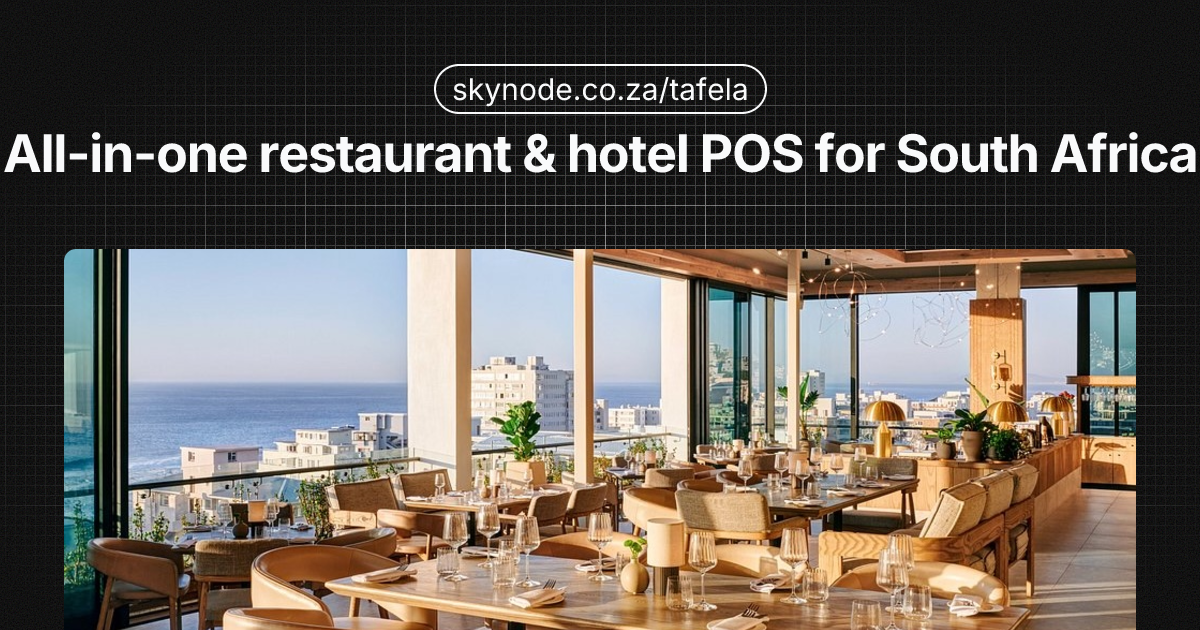
If you’re wondering how to start a restaurant in South Africa, you’re looking at one of the most demanding sectors in the country. The market is growing , but the trade, catering, and accommodation sector saw 298 liquidations in 2025. Success requires more than a great recipe; it requires a clear restaurant startup checklist South Africa operators can follow from concept to opening day.
This guide covers whether restaurant ownership fits you, concept and business plan, legal requirements (including the mandatory Certificate of Acceptability), location and fit-out, equipment and technology, hiring and wages (2026 minimum wage), menu and pricing, marketing, and launch. We include key numbers , labour ~37%, utilities ~34%, food ~29% , and rough startup cost ranges in Rand. For deeper dives, see our best restaurant POS systems for South Africa and restaurant load-shedding guide.
Is Opening a Restaurant in South Africa Right for You?
The market is growing, but running a restaurant is hard. Before you commit capital and years of your life, ask whether the opportunity fits your goals and risk tolerance. The South African restaurant market is on track to grow strongly to 2030; QSR holds the largest share and independents make up the majority of outlets. The restaurant startup checklist South Africa is about whether you’re prepared to execute, not whether the market exists.
The 298 liquidations in the trade, catering, and accommodation sector in 2025 are a reminder that many ventures don’t make it. Common reasons: under-capitalisation (running out of cash before break-even; plan for at least three to six months of working capital), poor location (not enough foot traffic, no parking, or a lease that doesn’t allow your use), and no cost control (labour ~37%, utilities ~34%, food ~29% must be tracked from day one , without a proper POS and food cost control, margins disappear). Opening a restaurant means long hours, especially in the first year. The right tools (POS, kitchen display, inventory, invoicing) reduce admin and help you stay on top of costs.
Concept, Business Plan, and Legal
Step 1: Develop your restaurant concept
Before you sign a lease or buy equipment, you need a clear concept: format, cuisine and target market, unique selling proposition, and location strategy.
Choose your format
Full-service restaurant , Table service, higher labour and ambience costs. Quick Service Restaurant (QSR) , Counter service, faster turnover; QSR holds the largest share of the SA market. Ghost kitchen , Delivery-only, lower fit-out costs. Food truck or mobile , Lower fixed costs; you still need licensing, COA where applicable, and a POS that works on the move. Your format drives space needs, labour model, and equipment list.
Cuisine and target market
Define who you’re serving and what you’re serving them. Family diners, office workers, students, tourists, or delivery-only customers each have different expectations and price sensitivity. Your cuisine and portion sizes should match your target market and your food cost target (typically 28–35% for food; see menu pricing strategy for more).
Unique selling proposition (USP)
What makes you different? Cuisine, neighbourhood focus, speed, ingredients, atmosphere, or value. Your USP should guide menu, branding, and marketing.
Location strategy
At the concept stage, decide whether you’re targeting high street, mall, office park, suburban, or delivery-only. A QSR in a mall needs high volume and fast turnover; a full-service suburban restaurant might rely more on regulars. Ghost kitchens can sit in cheaper, less visible locations. Align format, USP, and location type from the start.
Step 2: Create a business plan
A business plan forces you to think through revenue, costs, and funding. Include financial projections, startup costs, funding options, and break-even analysis.
Startup costs (rough ranges in R)
Project revenue from covers per day, average spend, and trading days; be conservative in year one. Project costs: rent, labour, utilities, food, packaging, marketing, debt servicing. Labour ~37%, utilities ~34%, food ~29% , use as a sanity check. Your POS and reporting will later give real numbers to refine these. Startup costs vary hugely by concept and location. Broad ranges (order of magnitude):
- Registration and licensing , R5,000 – R25,000 (CIPC, COA, liquor if applicable, zoning)
- Kitchen equipment , R150,000 – R800,000+ (depending on size and whether you buy new or second-hand)
- Furniture, decor, front-of-house , R50,000 – R300,000
- POS and technology , R3,000 – R30,000 upfront (or monthly-only with a system like Tafela from R199/month)
- Initial inventory , R20,000 – R100,000
- Pre-opening marketing , R10,000 – R50,000
- Working capital (3 months) , R100,000 – R500,000+ depending on size
A detailed cost table appears later in this guide. Funding options: own capital (reduces debt but ties up savings), bank loans (solid plan and often collateral), or investors/partners (capital and experience but diluted ownership). Ensure enough runway to break-even. Calculate how many covers per day you need at your projected average ticket to cover fixed and variable costs; if the required covers are unrealistically high for your location and format, rethink before you commit.
Step 3: Legal requirements and licensing
You cannot trade legally without meeting South African legal and regulatory requirements. Missing one item can delay opening or lead to fines and closure. Register with CIPC to establish your legal entity (Pty Ltd, sole proprietor); required for contracts, banking, and tax. If turnover is or will be R1 million or more in any 12-month period, you must register for VAT; your SARS invoicing and POS must be correct from day one.
Certificate of Acceptability (COA) , mandatory before trading
The Certificate of Acceptability (COA) is issued by the Department of Health (or municipal health authority) and certifies that your premises comply with food safety regulations. You must have a COA before you trade. The process involves an application (floor plan, equipment list), a fee, and an inspection. Inspectors check kitchen and storage layout, surfaces (smooth, rust-proof, non-toxic per Regulation R638), temperature control, pest control, and hygiene. Allow several weeks; do not open without a valid COA , operating without one is illegal and can result in closure and fines.
If you plan to sell alcohol, you need a liquor licence; requirements and timelines vary by province and municipality , apply early. Ensure your premises are zoned for restaurant/catering use; incorrect zoning can block your COA and liquor application. Check local requirements for food safety training (e.g. HACCP) and understand B-BBEE if relevant to tenders or partnerships.
Location, Kitchen, and Equipment
Step 4: Find and fit out your location
Location and premises affect foot traffic, delivery access, compliance, and day-to-day operations. Consider foot traffic and visibility, parking (many South African diners expect it), delivery pickup access if you’re on Uber Eats or Mr D, and signage per your lease. Negotiate lease length, rent escalation, who pays for what (rates, water, repairs), and break clauses; get clarity on permitted use and restrictions. Have a lawyer or advisor review the lease before you sign. Kitchen layout should support your menu and volume: prep, cooking, plating, dishwashing in a logical flow. Regulation R638 requires smooth, rust-proof, non-toxic food contact surfaces; plan the fit-out to meet these from the start. Storage must allow separation of raw and ready-to-eat food; refrigeration must be adequate for your volume and menu.
Step 5: Set up your kitchen and equipment
Kitchen equipment is one of the largest upfront costs. List stoves/ovens, fryers, grills, refrigeration, prep tables, dishwashing, ventilation, and smallwares per your menu and volume; prioritise must-haves for opening. Second-hand equipment can cut costs , ensure it’s in good condition, meets hygiene standards, and can be serviced. Plan for load-shedding: fridges and freezers must stay cold; your till and KDS need to keep working (generators, UPS, or inverters for critical circuits; see our restaurant load-shedding guide).
Kitchen display systems (KDS)
A kitchen display system replaces or supplements paper dockets with a screen showing orders in sequence, modifiers, and timing. It reduces errors and speeds service. Many POS systems include a KDS; plan for screens and placement in your kitchen layout.
POS and Technology
Step 6: Choose your POS and technology stack
Your point-of-sale system is the hub of operations. A proper POS tracks sales, sends orders to the kitchen, manages payments, and produces SARS-compliant invoices. Choosing it from day one , rather than “we’ll fix it later” , saves time, keeps you compliant, and gives you the data you need for food cost control and inventory management. Starting with a spreadsheet or cash-only approach creates catch-up work and compliance risk.
Look for offline mode (orders and payments when power or internet drops; see our restaurant load-shedding guide), SARS-compliant invoicing (per SARS tax invoice requirements), payment integration with Yoco or iKhokha (Yoco vs iKhokha for restaurants), and food costing (recipe builder, portion costing, COGS). If you use Uber Eats or Mr D, a POS that integrates orders into one flow reduces errors. See our best restaurant POS systems South Africa guide for a full comparison.
Team, Menu, and Marketing
Step 7: Hire and train your team
Labour is typically around 37% of restaurant costs. The national minimum wage from 1 March 2026 is R30.23 per hour; sectoral determinations can set different rates for some categories (e.g. R20–R22.25 per hour for certain smaller firms). Always verify the current rate for waiters, chefs, and casual workers. Hire first: head chef or kitchen manager, front-of-house supervisor, and key kitchen and service staff. The Basic Conditions of Employment Act (BCEA) governs hours, leave, overtime, and contracts , get proper employment contracts in place and keep records. Train staff on food safety (hygiene, temperature control, cross-contamination for COA), POS and kitchen display operations, and customer service.
Step 8: Plan your menu and pricing
Your menu and pricing directly affect revenue and food cost. A focused menu and clear menu pricing strategy set you up for profitability.
Menu size: less is more
A smaller, well-executed menu is easier to cost, prep, and quality-control than a long list of mediocre items. Start tight; you can expand once operations are stable.
Food cost targeting (28–35%)
Aim for food cost as a percentage of food revenue in the 28–35% range (varies by concept , see our food cost control guide). Use your POS recipe builder and inventory management to track actual cost and adjust portions or prices.
Pricing strategies
Price to cover food cost, labour, and overhead, plus a margin. Consider psychological pricing (e.g. R99 vs R100), combo deals for QSR, and premium positioning for higher-end items. Our restaurant menu pricing strategy article goes deeper.
Supplier relationships
Build relationships with reliable suppliers and compare prices, payment terms, and delivery frequency. A backup supplier for key items reduces risk. Use your POS and recipe costing to track spending per category; see our restaurant inventory management guide for more.
Step 9: Marketing before and after opening
You need customers from day one. Use social media to tease the concept and menu; build an email list or WhatsApp group for launch offers. A soft launch with friends, family, or local influencers lets you fix issues before the grand opening. Claim and optimise your Google Business Profile (NAP, hours, photos, category) and encourage early reviews. If you’re on Uber Eats or Mr D, register in advance and optimise menu and photos. Email, social, and in-store promotions keep customers coming back; track what works via your POS. Digital tipping and a smooth payment experience support reputation and repeat visits.
Launch and Optimise
Step 10: Launch and first months
A soft opening lets you test operations and train staff with a smaller audience; many operators then do a formal opening with promotions. First-month priorities: stabilise orders to the kitchen display, keep payments and SARS invoicing correct, and watch labour, food, and utilities via your POS and food cost reports. Avoid ignoring cost from week one, over- or understaffing, and relying on a POS that fails during load-shedding (see our restaurant load-shedding guide). Review sales, costs, and feedback weekly; the restaurant startup checklist South Africa evolves as you learn.
Startup Costs and Common Questions
Restaurant startup cost breakdown
Figures are indicative and vary by concept, location, and scale.
| Cost category | Low (R) | High (R) | Notes |
|---|---|---|---|
| Registration & licensing (CIPC, COA, liquor, zoning) | 5,000 | 25,000 | COA and liquor can take time; budget for delays |
| Kitchen equipment | 150,000 | 800,000+ | New vs second-hand; size and cuisine dependent |
| Furniture & decor | 50,000 | 300,000 | Dining and front-of-house |
| POS & technology | 3,000 | 30,000 | Or R199–R999/mo with Tafela and similar |
| Initial inventory (food, packaging) | 20,000 | 100,000 | Depends on menu and storage |
| Pre-opening marketing | 10,000 | 50,000 | Social, soft launch, signage |
| Working capital (3 months) | 100,000 | 500,000+ | Rent, wages, utilities, food until break-even |
Total (rough range): R338,000 – R1,805,000+. Add a buffer for unexpected costs and delays.
Frequently asked questions
How much does it cost to open a restaurant in South Africa?
Costs vary widely. A small café or takeaway might open for R300,000–R600,000 including working capital; a full-service restaurant in a prime location can exceed R1.5 million. See the cost table above. Plan for at least three months of working capital before break-even.
Do I need a liquor licence?
Yes, if you sell alcohol. Requirements differ by province and municipality; apply early , approval can take several months.
What is a Certificate of Acceptability (COA)?
The COA is issued by the Department of Health (or municipal health authority) and certifies that your premises meet food safety regulations. You must have one before you trade; operating without one is illegal and can result in closure and fines.
How long does it take to open a restaurant?
Plan for three to twelve months or more. Location, lease, fit-out, COA, and (if applicable) liquor licence take time; build buffer for delays.
What are the biggest mistakes new restaurant owners make?
Common mistakes: under-capitalisation, poor location, ignoring cost control, opening without a COA or proper SARS invoicing, no offline-capable POS (load-shedding kills sales), and overcomplicated menus. Follow a clear restaurant startup checklist South Africa and use the right tools from day one.
Starting a restaurant in South Africa demands careful planning: a solid concept, realistic business plan, full legal compliance (including the mandatory COA), the right location and equipment, and a POS that keeps you trading through load-shedding and SARS-compliant. Manage labour (~37%), utilities (~34%), and food (~29%) from day one.
See how Tafela keeps your kitchen running, your food cost visible, and your invoices SARS-compliant , even when the power goes out. Take control of your restaurant.
Written by
Tafela Team