
Property Development Cash Flow Software (SA): S-Curve, Drawdowns & Funding
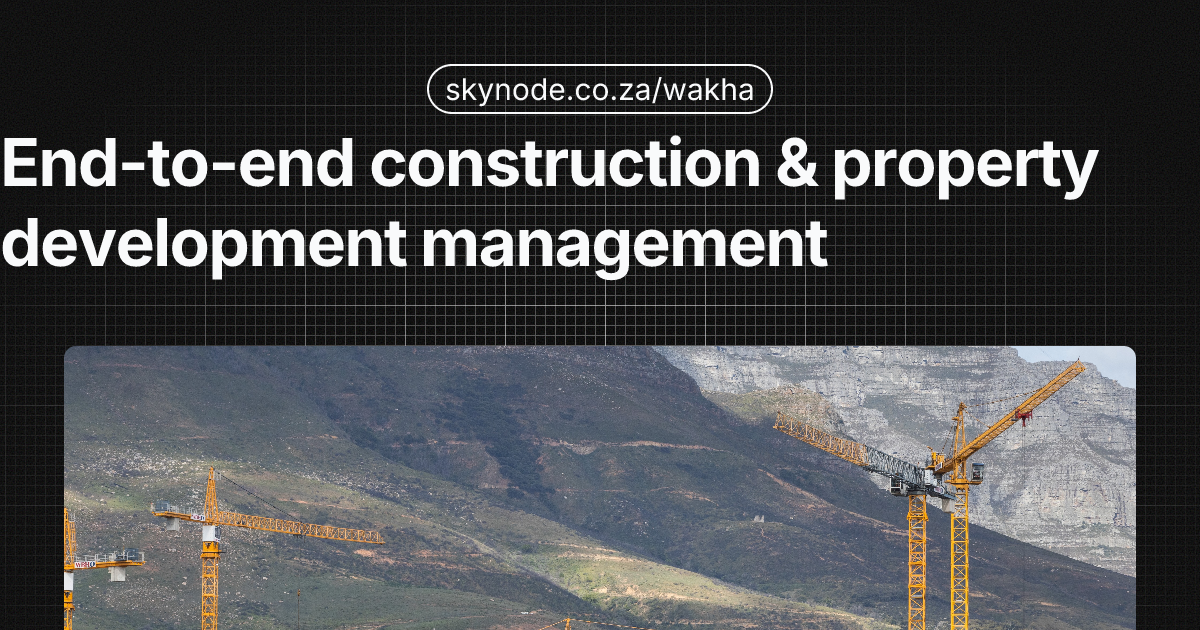
A profitable development can still fail. Not because the numbers were wrong overall, but because the money ran out at the wrong moment — a drawdown that came late, a cost that landed early, a sales tranche that slipped a quarter. Developments are funded against a curve, not a lump sum, and the gap between when you spend and when you are paid is where a solvent-looking project quietly runs aground. Cash flow, not profit, is what stalls a site mid-build.
This guide explains development cash flow and funding software for South African developers — how drawdowns work, where finance cost bites, and the S-curve a lender expects to see — and why a live cash flow is the difference between a development that runs to completion and one that grinds to a halt three storeys up.
Why developments are funded on a curve
A development does not cost its money evenly. Early on, spend is modest — land, professional fees, early works. Then it accelerates sharply through the main build, peaks, and tapers off towards completion. Plotted over time, cumulative cost traces an S — slow, then steep, then flat. That S-curve is the shape every funder recognises and every development cash flow has to model.
Funders do not hand over the whole facility at once. They release it in drawdowns, against the S-curve, usually after verifying that the work claimed has actually been done. Revenue, meanwhile, arrives on its own timeline — deposits, then transfers as units complete and sell. The cash position at any moment is the difference between cumulative drawdowns plus sales and cumulative cost plus finance. When that difference goes negative and the facility is exhausted, the site stops, regardless of how profitable the scheme looks on paper.
The whole discipline of development cash flow is managing that curve: making sure the money available always stays ahead of the money needed, with enough margin to absorb the slip that always comes.
What development cash flow software should model
A cash flow tool earns its place by modelling timing, not just totals.
The S-curve and drawdowns
Cost phased across the programme, drawdowns mapped against it, and the resulting cash position over time. You should be able to see the trough — the point of maximum funding need — and confirm the facility covers it with room to spare. Wakha’s cash flow command center is built for this: VAT-aware projections, draw-downs and a live view against the bank’s reality.
Finance cost
On a long, debt-funded development, interest is not a footnote — it compounds against the drawn balance for the life of the project. A delay that extends the programme extends the finance cost, which is one reason approval and build slips hurt more than they first appear. Software should carry finance cost as a live line, not a back-of-envelope estimate.
Actuals against forecast
A forecast is only useful if reality is tracked against it. As the build proceeds, actual spend should update the curve, so the cash flow you are looking at reflects this week, not the assumptions from kick-off. Wakha’s budget management ties actuals, forecast and cost-to-complete together in ZAR, feeding the live cash flow.
The drawdown report
The practical output is the report a funder needs to release the next tranche: what has been spent, what has been done, what is claimed and how it maps to the facility. When the budget, the site progress and the cash flow read from one record, that report is a view of existing data rather than a day of reconciliation.
| Cash-flow element | Why it matters |
|---|---|
| Phased cost (S-curve) | Shows when money is needed, not just how much |
| Drawdown schedule | Maps facility against spend |
| Peak funding requirement | The trough the facility must cover |
| Finance cost | Compounds over the programme; grows with delay |
| Actuals vs forecast | Keeps the curve current, not aspirational |
Reading the cash flow like a funder
A developer and a funder look at the same cash flow with slightly different eyes, and the developer who learns to read it the funder’s way makes a stronger case for the facility.
The funder’s first question is the depth of the trough — the peak funding requirement — and whether the facility covers it with a margin for the slip that always comes. Their second is the quality of the assumptions underneath the curve: is the sales rate credible, is the contingency real, is the finance cost properly modelled? Their third is whether the developer can demonstrate progress against the curve at each drawdown, so that releases are backed by verified work rather than optimism. A cash flow that answers these clearly is one a funder can say yes to quickly.
This is why a live, well-structured cash flow is not just an internal tool but a financing asset. When the curve, the drawdowns and the finance cost are current and defensible, the conversation at each drawdown is short. When they are reconstructed from a stale spreadsheet, every drawdown becomes a negotiation about numbers nobody quite trusts.
Common cash-flow mistakes
A few mistakes recur, and they are all about timing rather than arithmetic. The first is building the cash flow once at kick-off and never updating it, so it captures the plan and then drifts from reality. The second is an optimistic sales rate that brings revenue forward on paper and masks the real depth of the trough. The third is underweighting finance cost, which on a long development compounds into a major line and grows with every delay. And the fourth is ignoring the lag between claiming work and receiving the drawdown, which can leave a developer funding the gap from their own pocket for longer than expected. Each of these is caught by a live cash flow that updates from the same record as the build.
Keeping the curve honest through the build
The failure mode is not usually a bad initial cash flow. It is a cash flow that goes stale. Built at kick-off in a spreadsheet, it captures the plan perfectly and then drifts from reality the moment the first variation lands or the first milestone slips. By the time someone rebuilds it, the warning it should have given — that the trough is deeper than the facility — has already arrived as a crisis.
A live cash flow avoids this by updating from the same record as the build. Wakha keeps the programme, the budget and the cash flow connected, so a slipped milestone moves the curve, a variation hits the forecast, and the peak funding requirement is always current. For a South African developer, everything is in ZAR with VAT handled, which is the form a local funder and a local QS actually work in.
This connection back to feasibility matters too: the cash flow the project runs on should be the one the deal was underwritten with. Wakha is extending its tooling toward early-stage land feasibility precisely so the S-curve you model before buying the site is the one you then manage through the build, rather than a forgotten spreadsheet replaced by a different live one.
If your development cash flow is a kick-off spreadsheet that no longer matches the site, see how Wakha keeps the curve, the drawdowns and the finance cost live in ZAR: explore Wakha.
Frequently Asked Questions
What is an S-curve in property development?
The S-curve is the shape of cumulative cost over a development’s life: slow at the start, steep through the main build, then flat towards completion. Funders use it to schedule drawdowns and to judge whether a facility covers the project’s peak funding need. Almost every development cash flow is modelled around this curve.
What is a drawdown?
A drawdown is a release of part of a development finance facility, usually paid after the funder verifies that the work claimed has been done. Developments are funded in a series of drawdowns against the S-curve rather than as a single lump sum, which is why timing and verification matter so much to staying solvent.
Why can a profitable development still run out of cash?
Because profit is about the whole project while cash flow is about timing. If cost lands before revenue arrives, or a drawdown is delayed, or sales slip, the cash position can go negative even though the scheme is profitable overall. When the facility is exhausted at that point, the site stalls. Managing the timing — the curve — is what prevents it.
Does Wakha handle development cash flow?
Yes. Wakha’s cash flow command center models VAT-aware projections and draw-downs, fed by budget management that ties actuals, forecast and cost-to-complete together in ZAR. Because the programme, budget and cash flow share one record, the curve stays current as the build proceeds rather than going stale in a spreadsheet.
What is the peak funding requirement?
The peak funding requirement is the deepest point of the cash-flow trough — the maximum amount the development needs to have available at any single moment, before sales and drawdowns start to outpace spend. It is the number a facility has to cover, with margin for slippage. Understating it is one of the most dangerous feasibility errors, because it is the point at which a site runs out of money mid-build.
How detailed should a development cash flow be?
Detailed enough to show timing honestly, but not so granular that it becomes impossible to maintain. The essentials are cost phased across the programme, revenue phased across sales or lease commencement, drawdowns mapped against cost, and finance cost modelled over the period. The test is whether it answers the funder’s questions — how deep is the trough, are the assumptions credible, can progress be verified — and whether it can be kept current as actuals come in.
Related Articles:
Written by
Wakha Team