
Residential Estate Development Software: Phasing & Handover
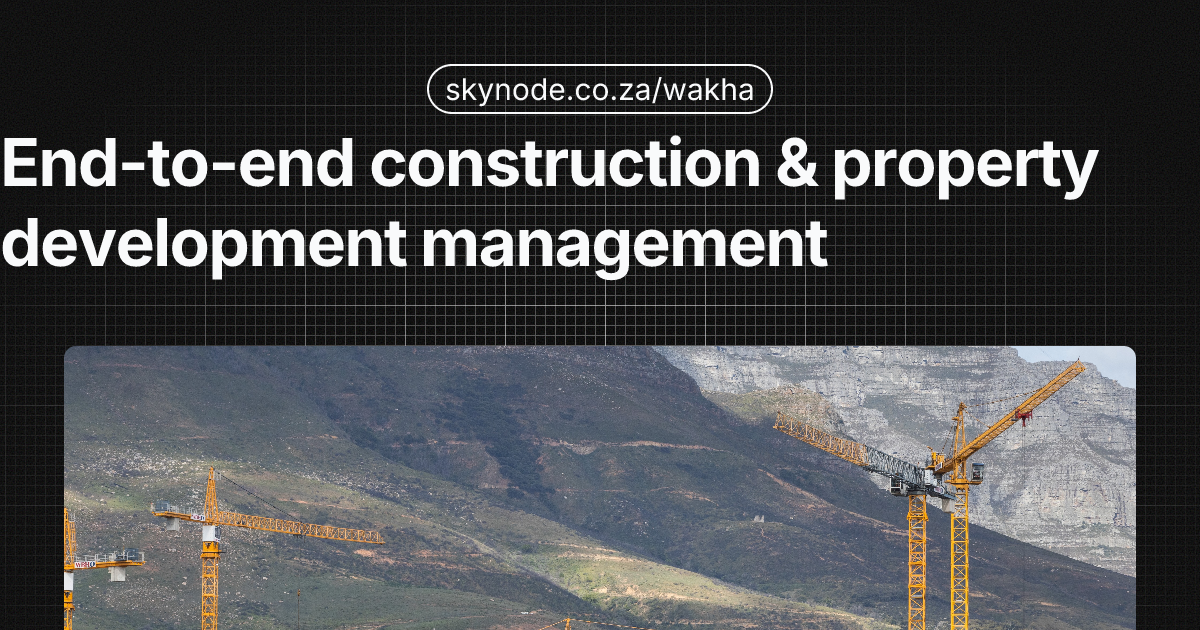
A large residential estate is not one build repeated a hundred times — it is a multi-year programme where bulk services, roads and reticulation must land in the right order before a single unit can transfer. In South Africa, where developers juggle NHBRC enrolment, municipal service agreements and staged township registration, this is where the money and the timeline live. The right residential estate development software gives you a single programme view: which phase is open, what shared infrastructure it depends on, and how many units are moving through snagging and handover right now. Get the sequencing wrong and Phase 3 stalls because the reticulation from Phase 1 was never signed off — a problem no single-house builder ever faces.
This guide explains how to run a phased residential estate development across its full programme in South Africa — from phase gates and services sequencing to handing over units at scale.
What makes an estate different from a single build
A single house is a project. An estate is a programme of projects that share infrastructure, a services backbone and a commercial timeline. Treating each unit as an isolated build is exactly how developers lose the thread.
The differences that break a normal project plan:
- Shared infrastructure comes first. Roads, stormwater, water and sewer reticulation, and electrical supply serve many units and must be built ahead of the unit phases that depend on them.
- Phases run in sequence and in parallel. Phase 1 units are being handed over while Phase 3 earthworks start — different disciplines, different stages, same balance sheet.
- The programme spans years. Municipal approvals, township registration and market absorption stretch delivery well beyond any single build cycle.
- Cost is shared, then split. Bulk services costs get allocated back across units — a topic we cover in depth in residential estate development software for South Africa, so we only touch it briefly here.
This guide focuses on the rest: phasing, programme control and handover at scale. That is where a general-purpose tool built for single buildings falls short, because it has no concept of one phase depending on another.
Phasing and phase gates
A phase gate is a go/no-go checkpoint between stages of the programme. You do not open the next phase until the previous one clears its gate — infrastructure signed off, funding drawn, approvals in hand.
Typical gates on an SA estate:
- Township established — general plan approved, township register opened, erven can be transferred.
- Bulk services accepted — municipality has taken over roads and reticulation, or a services agreement covers interim operation.
- NHBRC enrolment confirmed for the units in the phase before construction starts.
- Sales threshold met — a pre-sales percentage reached before releasing the next phase of construction.
Good residential estate development software makes each gate an explicit, visible checkpoint rather than a line buried in a project manager’s head. Wakha models phases as first-class objects, so a phase cannot show “ready to build” while its gate criteria are still open. For the broader development sequence, see how to develop a residential estate in South Africa.
Sequencing shared services before units
The single most common cause of a stalled estate is unit phases racing ahead of the bulk services that feed them. Reticulation, roads and electrical supply are dependencies — not parallel workstreams you can catch up on later.
A workable sequencing rule set:
- Bulk before internal. Bulk water, sewer and electrical connections to the municipal network precede internal reticulation.
- Reticulation before slabs. Water, sewer and electrical reticulation for a phase is in and tested before unit foundations in that phase.
- Roads before handover. Access roads and stormwater are complete before units in the phase reach occupation.
- Services acceptance before transfer. The municipality’s acceptance of services underpins the ability to transfer erven.
- Electrical supply energised before occupation. The municipal or Eskom connection and metering must be live and tested before units in the phase can be occupied.
When these dependencies are tracked as real links between infrastructure work and unit phases, the software can flag a unit phase that is scheduled to start before its services are ready — the warning a spreadsheet will never give you.
Managing a long programme
An estate programme is measured in years, and the risk is not any single task — it is losing the shape of the whole thing. Progress on Phase 1 hides slippage on Phase 4 services that will only bite in eighteen months.
What a programme view needs to hold:
- Every phase, every stage, on one timeline — services, construction, sales and handover side by side.
- Critical dependencies made visible — the services-to-units links that drive the whole sequence.
- Cash flow across the programme, since drawdowns and sales revenue arrive in a staggered rhythm. See property development cash flow software for South Africa for the funding side.
- A living record, not a snapshot, so the plan reflects what actually happened, not what was hoped for in the original Gantt.
A worked phase plan
The table below shows how a four-phase estate reads when phases and their service dependencies sit in one place:
| Phase | Units | Bulk / shared services | Phase gate | Target handover window |
|---|---|---|---|---|
| Phase 1 | 48 | Bulk water, sewer, main access road | Township register opened | Q3 2026 |
| Phase 2 | 62 | Internal reticulation, electrical MV network | Phase 1 services accepted | Q1 2027 |
| Phase 3 | 55 | Stormwater attenuation, secondary roads | Phase 2 pre-sales at 60% | Q4 2027 |
| Phase 4 | 40 | Reticulation extension, park & POS handover | Phase 3 services accepted | Q3 2028 |
The value is not the table itself — it is that each gate references the phase before it, so a slip in Phase 1 services propagates visibly down the programme instead of being discovered on site.
Tracking units through NHBRC, snagging and handover
At the unit level, an estate is a pipeline problem. Dozens or hundreds of units each move through the same stages — enrolment, construction, inspection, snag, transfer — but at different times. Managing that on paper is where handover quality quietly collapses.
The stages every unit passes through:
- NHBRC enrolment before construction, with the enrolment record attached to the unit. The NHBRC requirements for South Africa guide covers what each enrolment needs.
- Construction milestones tracked per unit so slow units surface early.
- Snag lists raised, assigned and closed out per unit, not per phase.
- NHBRC final inspection and any late-build enrolment obligations.
- Handover and transfer — occupation certificate, final snag sign-off, and conveyancing to lodge transfer.
Handover at scale means seeing, at a glance, how many units are enrolled, under construction, in snagging and transferred — across every open phase at once. Wakha tracks each unit as its own record inside its phase, so the estate-wide handover pipeline is a filter, not a fortnight of collating spreadsheets.
Why residential estate development software beats spreadsheets
Spreadsheets are fine for a single build. On a multi-year estate they fail in predictable ways:
- No live dependencies. A spreadsheet cannot warn you that a unit phase is starting before its reticulation is accepted.
- Snapshots go stale. By the time a programme tracker is updated, three site conditions have already changed.
- Version drift. Two site managers, two copies, two versions of the truth.
- No unit pipeline. Counting how many of 205 units are in snagging becomes a manual, error-prone census.
Purpose-built property development workflow software for South Africa keeps phases, services and units in one connected model — which is the difference between managing a programme and reacting to it.
Book a demo
See how Wakha keeps a multi-phase estate, its shared services and its unit handover pipeline in one programme view. Book a demo.
FAQ
How does phasing differ from just building units in order?
Phasing ties each group of units to the shared infrastructure it depends on and to a go/no-go gate. Building “in order” only sequences the units; phasing sequences the services, approvals and funding that make those units buildable and transferable.
Can residential estate development software track NHBRC and snagging per unit?
Yes. On an estate, each unit needs its own enrolment record, construction status and snag list. Tracking these per unit — rather than per phase — is what lets you report the estate-wide handover pipeline accurately across hundreds of units.
What happens if shared services fall behind on one phase?
A slip in a phase’s bulk services should propagate to every dependent phase automatically. With dependencies modelled explicitly, the software flags downstream phases that can no longer meet their gate, so you re-plan early instead of discovering the problem on site.
Related articles:
Written by
Wakha Team